
154 countries
(and areas)
 - Belize
- Benin
- Bhutan
- Bolivia
- Bonaire
- Bosnia and Herzegovina
- Botswana
- Brazil
- British Virgin Islands
- Brunei
- Bulgaria
- Cambodia
- Canada
- Cape Verde
- Chile
- China
- Costa Rica
- Croatia
- Cuba
- Curacao
- Cyprus
- Czech Republic
- Denmark
- Dominica
- Dominican Republic
- Egypt
- El Salvador
- England
- Estonia
- Eswatini (Swaziland)
- Ethiopia
- Fiji
- Finland
- France
- French Guiana
- Georgia
- Germany
- Gibraltar
- Greece
- Grenada
- Guadeloupe
- Guatemala
- Honduras
- Hong Kong
- Hungary
- Iceland
- India
- Indonesia
- Iran
- Ireland
- Israel
- Italy
- Jamaica
- Japan
- Jordan
- Kazakhstan
- Kenya
- Kosovo
- Kuwait
- Kyrgyzstan
- Laos
- Latvia
- Lebanon
- Lesotho
- Liechtenstein
- Lithuania
- Luxembourg
- Macau
- Madagascar
- Malawi
- Malaysia
- Maldives
- Malta
- Martinique
- Mexico
- Moldova
- Monaco
- Mongolia
- Montenegro
- Morocco
- Mozambique
- Namibia
- Nepal
- Netherlands
- New Zealand
- Nicaragua
- North Macedonia
- Northern Ireland
- Norway
- Oman
- Pakistan
- Palestine
- Peru
- Philippines
- Poland
- Portugal
- Qatar
- Republic of Korea
- Romania
- Russia
- Saint Kitts and Nevis
- Saint Lucia
- Saint Martin
- Saint Vincent and the Grenadines
- San Marino
- São Tomé and Principe
- Saudi Arabia
- Scotland
- Senegal
- Serbia
- Singapore
- Sint Maarten
- Slovakia
- Slovenia
- South Africa
- Spain
- Sri Lanka
- Suriname
- Sweden
- Switzerland
- Tajikistan
- Tanzania
- Thailand
- The Gambia
- Tibet
- Togo
- Transnistria
- Trinidad and Tobago
- Tunisia
- Turkey
- Turkmenistan
- Uganda
- United Arab Emirates
- United States
- Uruguay
- Uzbekistan
- Vatican City
- Vietnam
- Wales
- Zambia
- Zanzibar
- Belize
- Benin
- Bhutan
- Bolivia
- Bonaire
- Bosnia and Herzegovina
- Botswana
- Brazil
- British Virgin Islands
- Brunei
- Bulgaria
- Cambodia
- Canada
- Cape Verde
- Chile
- China
- Costa Rica
- Croatia
- Cuba
- Curacao
- Cyprus
- Czech Republic
- Denmark
- Dominica
- Dominican Republic
- Egypt
- El Salvador
- England
- Estonia
- Eswatini (Swaziland)
- Ethiopia
- Fiji
- Finland
- France
- French Guiana
- Georgia
- Germany
- Gibraltar
- Greece
- Grenada
- Guadeloupe
- Guatemala
- Honduras
- Hong Kong
- Hungary
- Iceland
- India
- Indonesia
- Iran
- Ireland
- Israel
- Italy
- Jamaica
- Japan
- Jordan
- Kazakhstan
- Kenya
- Kosovo
- Kuwait
- Kyrgyzstan
- Laos
- Latvia
- Lebanon
- Lesotho
- Liechtenstein
- Lithuania
- Luxembourg
- Macau
- Madagascar
- Malawi
- Malaysia
- Maldives
- Malta
- Martinique
- Mexico
- Moldova
- Monaco
- Mongolia
- Montenegro
- Morocco
- Mozambique
- Namibia
- Nepal
- Netherlands
- New Zealand
- Nicaragua
- North Macedonia
- Northern Ireland
- Norway
- Oman
- Pakistan
- Palestine
- Peru
- Philippines
- Poland
- Portugal
- Qatar
- Republic of Korea
- Romania
- Russia
- Saint Kitts and Nevis
- Saint Lucia
- Saint Martin
- Saint Vincent and the Grenadines
- San Marino
- São Tomé and Principe
- Saudi Arabia
- Scotland
- Senegal
- Serbia
- Singapore
- Sint Maarten
- Slovakia
- Slovenia
- South Africa
- Spain
- Sri Lanka
- Suriname
- Sweden
- Switzerland
- Tajikistan
- Tanzania
- Thailand
- The Gambia
- Tibet
- Togo
- Transnistria
- Trinidad and Tobago
- Tunisia
- Turkey
- Turkmenistan
- Uganda
- United Arab Emirates
- United States
- Uruguay
- Uzbekistan
- Vatican City
- Vietnam
- Wales
- Zambia
- Zanzibar


Copyright 2004 - 2026
Veeronline.nl Travel Adventures

Home > Montenegro > Hospitable Montenegro > Travelogue day 6
Travelogue Hospitable Montenegro
August 111 2014 (11 days)
Montenegro > Traveling by train
Dag 6 - Wednesday, August 6, 2014For my breakfast, I have to go to another hotel. Both hotels are owned by the same proprietor. I walk along the Main Street and cross the square diagonally to reach Hotel Brile. In the breakfast room, a full spread is already laid out for me, with omelet, fruit, and yogurt. A welcome treat after the days in the mountains. After breakfast, I walk back to my own hotel, where I am picked up to go to Kolasin station. While I’m still in my room, there’s a knock at the door. The hotel employee explains, in half English and half Montenegrin, that I need to hurry for the train. I gather my luggage and follow him, even though it’s still ten minutes before the agreed-upon time. Downstairs, the driver is waiting. He seems nervous too. Quickly, he drives me to the station, which is about one and a half kilometers outside Kolasin. After a few bends, I can already see the building. The driver walks with me to the platform, trying to explain something in broken English about the tickets, clearly relieved when I fill him in that I already know tickets are bought on the train. He calls across the platform to some station staff to confirm the train time.
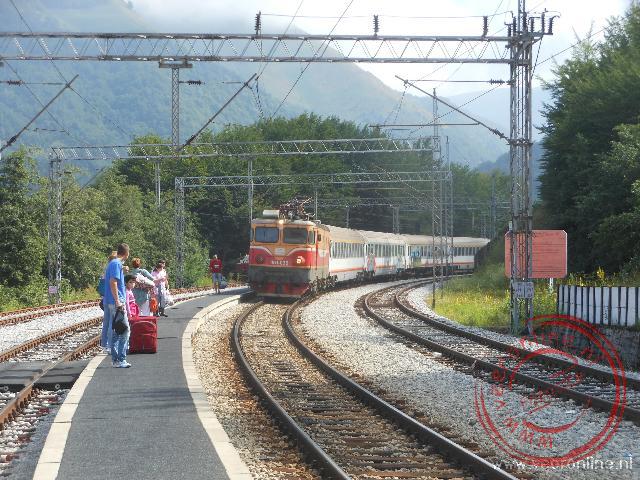
I’m more than half an hour early, which gives me a chance to observe families arriving for the train. When I hear the train approaching, I go to the platform. I watch the train arrive at the station with complete calm. I find a compartment with an empty seat. As soon as the train starts moving, I see a deep valley to my right. The train winds its way high through the mountains on a single-track line. Frequently, it enters tunnels; on some stretches, I think there are more tunnels than open track. The train stops at every small station. After about an hour and a half, the terrain flattens, and the train finally enters Podgorica. A girl across from me points out the approach of my destination. On the platform, I meet Vlado again. He tells me he has been in contact with Montenegro Airlines. They say there are many problems with baggage coming from Italy—currently more than 200 pieces are missing. That’s too many to carry on a single flight alongside regular baggage. Vlado prepares me for the possibility that my luggage may not arrive before Monday at all. In that case, it would be sent back to the Netherlands. Sigh. While I process this news, I follow him to the car. We quickly drive out of the capital. Vlado jokes that if tourists ask what to do in Podgorica, he advises them to find a pub and order a beer. That’s it. We head toward the former capital, Cetinje. Cetinje was the capital of the Kingdom of Montenegro until World War I. After the war, Montenegro became part of the Kingdom of Serbs, Croats, and Slovenes, the later Yugoslavia. Many old buildings and 17th-century embassies now serve as museums. I stroll through the small town center. Passing the red-colored former palace of King Nikola Petrovic and the old royal church, I reach the Cetinje Monastery. Inside, I admire the beautiful frescoes in the small chapel. Before heading into the Lovcen National Park mountains, I quickly order lunch at a terrace. Dark clouds hang above the town, and thunder rumbles in the distance. It’s no longer a question of if it will rain, but when. To be safe, I look for a simple poncho in the shops. If that fails, a sturdy umbrella will do. Then Vlado drives me to the mausoleum of Njegos, an important prince-bishop of Montenegro. A winding road takes me higher and higher into the nature reserve.
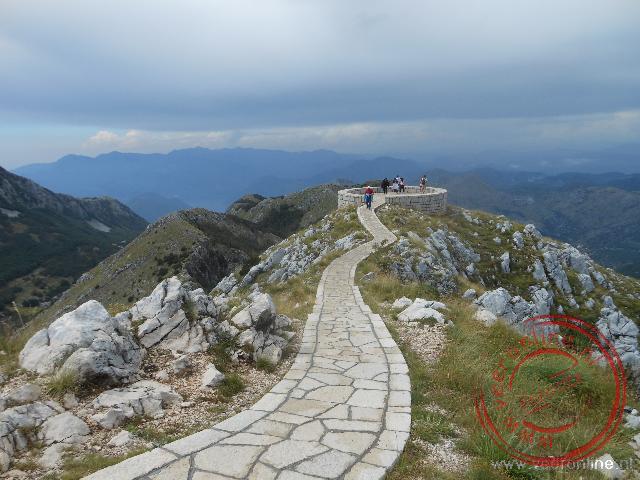
The mausoleum sits on the second-highest peak of Lovcen. At the parking lot, I say goodbye to Vlado. I’ll see him again in two days in Kotor. I climb the 461 steps to the mausoleum at 1,650 meters. Part of the stairway goes through the mountain. From the top, I have a wide view of the surroundings, and in the distance, I can also see Cetinje. Judging by the water, it has rained heavily here recently. Only now do I realize I’ve mostly escaped the rain. I enter the mausoleum but am more interested in the viewpoint behind it. From here, I can see the entire Lovcen National Park. As I start walking again, the sun even begins to peek through. Vlado had shown me the hiking track to Njegusi—a path that would take me down to around 1,000 meters in about two and a half hours. “You can’t go wrong,” Vlado had said. Only at one crucial junction must I turn left. I follow the path through trees and grassy meadows. Because of the recent rain, my shoes quickly become soaked, and water seeps into my socks. When the path leads into a village, I realize I’ve never seen a junction. Desperately, I check the map. Am I in front of the church in Njegusi or in Bukovica? Not seeing anyone to ask, I continue to the main road. Here, the signs confirm that I am indeed in Njegusi. At the village square, there is a cozy terrace where I order a drink. I ask the waiter about my lodging, and he points me to a small complex of ten wooden cottages, about a kilometer further along the road. A little later, when I step into the restaurant, I am warmly welcomed. I’m taken to my lodging: a triangular cottage with three beds downstairs and three beds upstairs. It’s just as well I have no luggage, because there’s barely space for it. In the evening, after dinner, I return to my cottage and meet two German travelers. They have their tent set up in front of my bungalow and are sitting on the bench by my cottage. We strike up a conversation, and they offer me a glass of wine. I end up staying until past eleven.
 Montenegro
  The clear mountain water is perfectly drinkable
 The overgrown mountain path sees few hikers
 View of the impressive Bay of Kotor
 The train to Podgorica arrives in Kolain
Travelogue Hospitable Montenegro
Dag 2 | Montenegro > Hiking through Durmitor National Park
Dag 3 | Montenegro > Through the Tara Gorge to Goleš
Dag 4 | Montenegro > Over the mountain ridge to Vranjak
Dag 5 | Montenegro > Lost on the way to Kolašin
Dag 6 | Montenegro > Traveling by train
Dag 7 | Montenegro > Descending to Kotor
Dag 8 | Montenegro > From Budva to Sveti Stefan
Dag 9 | Montenegro > Kayaking on Lake Skadar
Dag 10 | Montenegro > Cycling past the vineyards
Dag 11 | Montenegro > Going home without luggage