
154 countries
(and areas)
 - Belize
- Benin
- Bhutan
- Bolivia
- Bonaire
- Bosnia and Herzegovina
- Botswana
- Brazil
- British Virgin Islands
- Brunei
- Bulgaria
- Cambodia
- Canada
- Cape Verde
- Chile
- China
- Costa Rica
- Croatia
- Cuba
- Curacao
- Cyprus
- Czech Republic
- Denmark
- Dominica
- Dominican Republic
- Egypt
- El Salvador
- England
- Estonia
- Eswatini (Swaziland)
- Ethiopia
- Fiji
- Finland
- France
- French Guiana
- Georgia
- Germany
- Gibraltar
- Greece
- Grenada
- Guadeloupe
- Guatemala
- Honduras
- Hong Kong
- Hungary
- Iceland
- India
- Indonesia
- Iran
- Ireland
- Israel
- Italy
- Jamaica
- Japan
- Jordan
- Kazakhstan
- Kenya
- Kosovo
- Kuwait
- Kyrgyzstan
- Laos
- Latvia
- Lebanon
- Lesotho
- Liechtenstein
- Lithuania
- Luxembourg
- Macau
- Madagascar
- Malawi
- Malaysia
- Maldives
- Malta
- Martinique
- Mexico
- Moldova
- Monaco
- Mongolia
- Montenegro
- Morocco
- Mozambique
- Namibia
- Nepal
- Netherlands
- New Zealand
- Nicaragua
- North Macedonia
- Northern Ireland
- Norway
- Oman
- Pakistan
- Palestine
- Peru
- Philippines
- Poland
- Portugal
- Qatar
- Republic of Korea
- Romania
- Russia
- Saint Kitts and Nevis
- Saint Lucia
- Saint Martin
- Saint Vincent and the Grenadines
- San Marino
- São Tomé and Principe
- Saudi Arabia
- Scotland
- Senegal
- Serbia
- Singapore
- Sint Maarten
- Slovakia
- Slovenia
- South Africa
- Spain
- Sri Lanka
- Suriname
- Sweden
- Switzerland
- Tajikistan
- Tanzania
- Thailand
- The Gambia
- Tibet
- Togo
- Transnistria
- Trinidad and Tobago
- Tunisia
- Turkey
- Turkmenistan
- Uganda
- United Arab Emirates
- United States
- Uruguay
- Uzbekistan
- Vatican City
- Vietnam
- Wales
- Zambia
- Zanzibar
- Belize
- Benin
- Bhutan
- Bolivia
- Bonaire
- Bosnia and Herzegovina
- Botswana
- Brazil
- British Virgin Islands
- Brunei
- Bulgaria
- Cambodia
- Canada
- Cape Verde
- Chile
- China
- Costa Rica
- Croatia
- Cuba
- Curacao
- Cyprus
- Czech Republic
- Denmark
- Dominica
- Dominican Republic
- Egypt
- El Salvador
- England
- Estonia
- Eswatini (Swaziland)
- Ethiopia
- Fiji
- Finland
- France
- French Guiana
- Georgia
- Germany
- Gibraltar
- Greece
- Grenada
- Guadeloupe
- Guatemala
- Honduras
- Hong Kong
- Hungary
- Iceland
- India
- Indonesia
- Iran
- Ireland
- Israel
- Italy
- Jamaica
- Japan
- Jordan
- Kazakhstan
- Kenya
- Kosovo
- Kuwait
- Kyrgyzstan
- Laos
- Latvia
- Lebanon
- Lesotho
- Liechtenstein
- Lithuania
- Luxembourg
- Macau
- Madagascar
- Malawi
- Malaysia
- Maldives
- Malta
- Martinique
- Mexico
- Moldova
- Monaco
- Mongolia
- Montenegro
- Morocco
- Mozambique
- Namibia
- Nepal
- Netherlands
- New Zealand
- Nicaragua
- North Macedonia
- Northern Ireland
- Norway
- Oman
- Pakistan
- Palestine
- Peru
- Philippines
- Poland
- Portugal
- Qatar
- Republic of Korea
- Romania
- Russia
- Saint Kitts and Nevis
- Saint Lucia
- Saint Martin
- Saint Vincent and the Grenadines
- San Marino
- São Tomé and Principe
- Saudi Arabia
- Scotland
- Senegal
- Serbia
- Singapore
- Sint Maarten
- Slovakia
- Slovenia
- South Africa
- Spain
- Sri Lanka
- Suriname
- Sweden
- Switzerland
- Tajikistan
- Tanzania
- Thailand
- The Gambia
- Tibet
- Togo
- Transnistria
- Trinidad and Tobago
- Tunisia
- Turkey
- Turkmenistan
- Uganda
- United Arab Emirates
- United States
- Uruguay
- Uzbekistan
- Vatican City
- Vietnam
- Wales
- Zambia
- Zanzibar


Copyright 2004 - 2026
Veeronline.nl Travel Adventures

Home > Lebanon > Surprising Lebanon > Travelogue day 2
Travelogue Surprising Lebanon
May 1725 2023 (9 days)
Lebanon > The Beiteddine Palace
Dag 2 - Thursday, 18 May 2023I slept well last night. I wake up to the alarm clock. I take a shower and get dressed. In the breakfast room, I find most of the fellow travelers again. I practice if I still remember all their names. For two faces, I can’t recall the names. They are Hans and Susanne. They arrived yesterday on their own. So it makes sense that I haven’t spoken to them yet. The travel group is now complete. We start the day with a bus tour through Beirut. Soon I see the Corniche, the wide boulevard along the sea. We stop at the detached Pigeon Rocks. The rocks are 46 meters high

. In summer, people sometimes jump off the rocks, Rami says. That’s not for me. We drive on to Martyrs' Square in downtown Beirut. On this square stands the Mohammed Al-Amin mosque, the largest mosque in the country. Martyrs' Square has often been the scene of large-scale demonstrations in Lebanon’s turbulent history. From this square, we continue on foot. Immediately, very young children come begging for money. Rami asks us not to give money. Children belong in school. With a slight annoyance in his voice, Rami explains that these are mostly children of Syrian refugees. The families often receive money from the United Nations. The Syrian men work normally. The begging by children is not needed at all. We walk past the government buildings. The district around the buildings has been hermetically sealed off for a few years. Without a permit, Lebanese people are not allowed into this area. The closure is the result of protests against the poor economic situation and soaring inflation in Lebanon. The closure means that restaurants, shops, and houses within the sealed-off area now stand empty. The buildings are no longer maintained and await decay. The Place de l'Étoile square around the clock tower must have been a lively place with a French atmosphere in the past. By the letters ‘I love Beirut’ we take a group photo. Across the street, we visit Saint Louis Cathedral.

As tourists, we are allowed to enter the district around the government buildings. Here lie the remains of a Roman bathhouse and the beautifully fresco-decorated Greek Orthodox Saint George Cathedral. What a shame the church is no longer in use. On the other side, we come back to the mosque. The National Museum is located on the ‘Green Line,’ the dividing line during the Lebanese civil war between 1975 and 1990. The Islamic population lived west of this buffer zone. The Christian population east of it. It is not easy to get to the museum by bus. The traffic is at a standstill. We slowly make progress. The National Museum is the most important museum for archaeology in Lebanon. In the basement, the history of Lebanon is shown through a timeline: the Phoenician period, Roman era, Byzantine times, the Middle Ages, and the Ottomans. Each period influenced the architecture of temples and buildings. Rami shows us the highlights of the museum at a challenging pace. Those who want can return later in the week to view the collection more calmly.

He shows the white marble Phoenician sarcophagi from Sidon, the Roman tomb from Tyre, and the remarkably well-preserved Maronite mummies from 1283. Many of the archaeological sites we will visit later this week. Before leaving the center of Beirut, we drive past the harbor. On August 4, 2020, a shipment of ammonium nitrate exploded here. The force was so enormous that large parts of the city were damaged. Hundreds of people died. Windows shattered up to twenty kilometers away. Rami is convinced Israel is responsible for the explosion. The official explanation attributes it to an unfortunate fire with devastating consequences. At the harbor, the damage is still visible. The damaged warehouse and a twisted crane are silent witnesses of this enormous disaster. We leave Beirut and drive south along the coast. Along the route, there is a lot of building even outside the city. Practically the entire coastal strip is built up. Remarkably, these are mostly apartments. In other southern European countries, you often see detached houses prepared for future additional floors. Curtains hang along the apartment balconies. This is probably the cheapest form of sun protection. Some curtains are weathered and worn. At Khiam El Damour, we turn off and enter the Chouf Mountains. We pass a police checkpoint. So far, the police controls have been mild. I had expected more on the way. We stop at Deir al-Qamar. In the 16th century, during the Ottoman period, Deir al-Qamar became the capital of the Emirate of Mount Lebanon. The Emir’s palace is now used by the municipal council. Next to it stands the 17th-century synagogue. The village has retained its remarkably picturesque appearance with typical stone houses and red tile roofs. We take a short walk through the narrow streets. Due to the elevation changes in the mountains, the streets mainly consist of stairs. Just outside Deir al-Qamar, lunch is ready. Rami placed the order beforehand, so lunch is ready when we arrive. Orders in restaurants can otherwise take a long time. The choice is meat or vegetarian. Some mezze appetizers are already ready when we arrive. Fine for lunch. Rami warns that this is only the starter. Soon, plates with chicken, rice, and salad follow. For the last destination today, we continue to Beiteddine Palace.
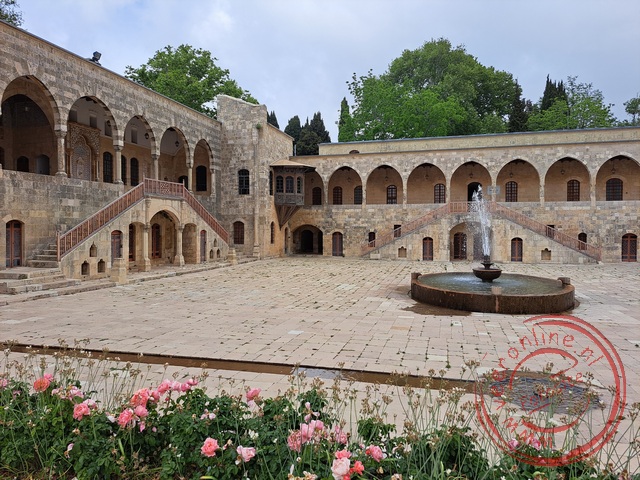
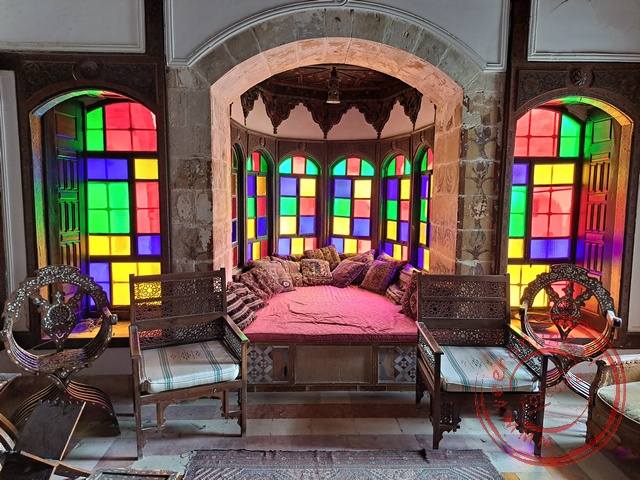
The Emir of the Mount Lebanon Emirate, Bashir II, had Beiteddine Palace built in 1788. Nowadays, the palace is the official summer residence of the Lebanese president. I walk through the entrance gate. The square in front of the palace is immense. Across lies the palace. I climb the stairs and enter through the gate into the palace. I arrive at the courtyard. Surrounding are various reception rooms, all beautifully decorated with woodcarvings, marble floors, and colorful stained glass. The president uses the palace in summer. He is not present now. We also visit the presidential reception hall. Via the hammam, the Emir’s bathhouse, we come to the mosaic floors in the rooms beneath the palace. At the end of the afternoon, we drive back to Beirut.
The impressions of today were beautiful but also exhausting. I lie down on the bed for a while. For dinner, we agreed to meet in the lobby at eight o’clock. To avoid going with too large a group, we split up. It is not easy to find a cozy restaurant. Either it is a sort of kebab place or Italian. When we ask some young people on the street, we are directed to a good restaurant. It turns out there is no place there. We decide to take a seat at the restaurant opposite. This turns out to be a great choice. We end the evening on a terrace on Makdisi Street. Local Lebanese sit around the waterpipe. A cozy atmosphere.
 Lebanon
 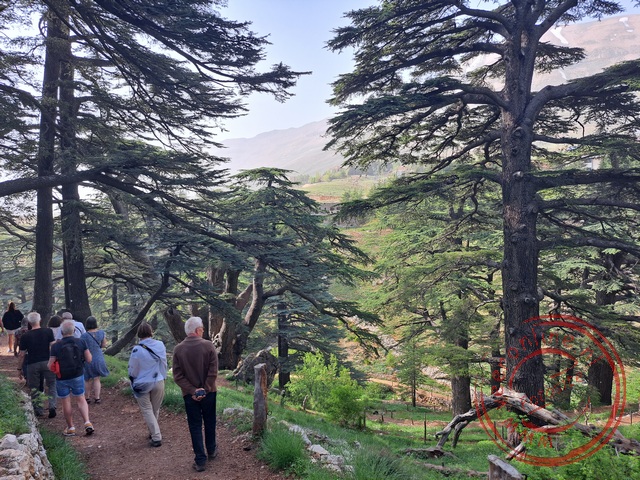 The cedar trees can live up to a thousand years old
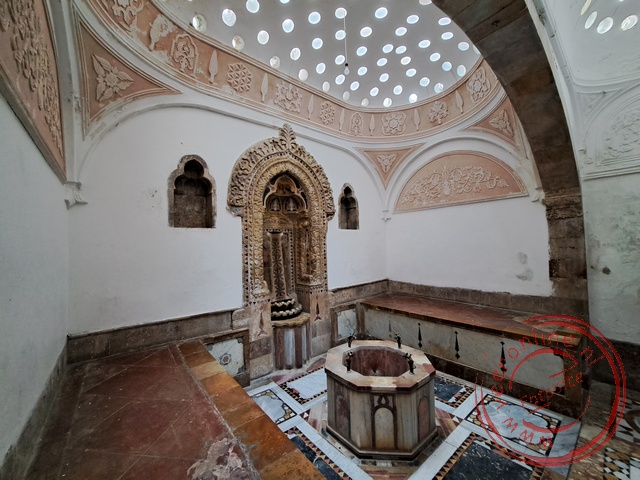 The beautiful bathhouse of the Emir
 The coverings protect against the strong sun
 The luxury Grey hotel is still closed after the huge port explosion in 2020
Travelogue Surprising Lebanon
Dag 2 | Lebanon > The Beiteddine Palace
Dag 3 | Lebanon > The Baalbek archaeological site
Dag 4 | Lebanon > Sidon and Tyre
Dag 5 | Lebanon > Wandering through Beirut
Dag 6 | Lebanon > The Lebanese Cedar Trees
Dag 7 | Lebanon > The Jeita Grottoes
Dag 8 | Lebanon > The last day in Byblos
Dag 9 | Lebanon > Waiting for the luggage