
154 countries
(and areas)
 - Belize
- Benin
- Bhutan
- Bolivia
- Bonaire
- Bosnia and Herzegovina
- Botswana
- Brazil
- British Virgin Islands
- Brunei
- Bulgaria
- Cambodia
- Canada
- Cape Verde
- Chile
- China
- Costa Rica
- Croatia
- Cuba
- Curacao
- Cyprus
- Czech Republic
- Denmark
- Dominica
- Dominican Republic
- Egypt
- El Salvador
- England
- Estonia
- Eswatini (Swaziland)
- Ethiopia
- Fiji
- Finland
- France
- French Guiana
- Georgia
- Germany
- Gibraltar
- Greece
- Grenada
- Guadeloupe
- Guatemala
- Honduras
- Hong Kong
- Hungary
- Iceland
- India
- Indonesia
- Iran
- Ireland
- Israel
- Italy
- Jamaica
- Japan
- Jordan
- Kazakhstan
- Kenya
- Kosovo
- Kuwait
- Kyrgyzstan
- Laos
- Latvia
- Lebanon
- Lesotho
- Liechtenstein
- Lithuania
- Luxembourg
- Macau
- Madagascar
- Malawi
- Malaysia
- Maldives
- Malta
- Martinique
- Mexico
- Moldova
- Monaco
- Mongolia
- Montenegro
- Morocco
- Mozambique
- Namibia
- Nepal
- Netherlands
- New Zealand
- Nicaragua
- North Macedonia
- Northern Ireland
- Norway
- Oman
- Pakistan
- Palestine
- Peru
- Philippines
- Poland
- Portugal
- Qatar
- Republic of Korea
- Romania
- Russia
- Saint Kitts and Nevis
- Saint Lucia
- Saint Martin
- Saint Vincent and the Grenadines
- San Marino
- São Tomé and Principe
- Saudi Arabia
- Scotland
- Senegal
- Serbia
- Singapore
- Sint Maarten
- Slovakia
- Slovenia
- South Africa
- Spain
- Sri Lanka
- Suriname
- Sweden
- Switzerland
- Tajikistan
- Tanzania
- Thailand
- The Gambia
- Tibet
- Togo
- Transnistria
- Trinidad and Tobago
- Tunisia
- Turkey
- Turkmenistan
- Uganda
- United Arab Emirates
- United States
- Uruguay
- Uzbekistan
- Vatican City
- Vietnam
- Wales
- Zambia
- Zanzibar
- Belize
- Benin
- Bhutan
- Bolivia
- Bonaire
- Bosnia and Herzegovina
- Botswana
- Brazil
- British Virgin Islands
- Brunei
- Bulgaria
- Cambodia
- Canada
- Cape Verde
- Chile
- China
- Costa Rica
- Croatia
- Cuba
- Curacao
- Cyprus
- Czech Republic
- Denmark
- Dominica
- Dominican Republic
- Egypt
- El Salvador
- England
- Estonia
- Eswatini (Swaziland)
- Ethiopia
- Fiji
- Finland
- France
- French Guiana
- Georgia
- Germany
- Gibraltar
- Greece
- Grenada
- Guadeloupe
- Guatemala
- Honduras
- Hong Kong
- Hungary
- Iceland
- India
- Indonesia
- Iran
- Ireland
- Israel
- Italy
- Jamaica
- Japan
- Jordan
- Kazakhstan
- Kenya
- Kosovo
- Kuwait
- Kyrgyzstan
- Laos
- Latvia
- Lebanon
- Lesotho
- Liechtenstein
- Lithuania
- Luxembourg
- Macau
- Madagascar
- Malawi
- Malaysia
- Maldives
- Malta
- Martinique
- Mexico
- Moldova
- Monaco
- Mongolia
- Montenegro
- Morocco
- Mozambique
- Namibia
- Nepal
- Netherlands
- New Zealand
- Nicaragua
- North Macedonia
- Northern Ireland
- Norway
- Oman
- Pakistan
- Palestine
- Peru
- Philippines
- Poland
- Portugal
- Qatar
- Republic of Korea
- Romania
- Russia
- Saint Kitts and Nevis
- Saint Lucia
- Saint Martin
- Saint Vincent and the Grenadines
- San Marino
- São Tomé and Principe
- Saudi Arabia
- Scotland
- Senegal
- Serbia
- Singapore
- Sint Maarten
- Slovakia
- Slovenia
- South Africa
- Spain
- Sri Lanka
- Suriname
- Sweden
- Switzerland
- Tajikistan
- Tanzania
- Thailand
- The Gambia
- Tibet
- Togo
- Transnistria
- Trinidad and Tobago
- Tunisia
- Turkey
- Turkmenistan
- Uganda
- United Arab Emirates
- United States
- Uruguay
- Uzbekistan
- Vatican City
- Vietnam
- Wales
- Zambia
- Zanzibar


Copyright 2004 - 2026
Veeronline.nl Travel Adventures
Home > Cape Verde > The Islands of Cape Verde > Travelogue day 6
Travelogue The Islands of Cape Verde
March 1927 2022 (9 days)
Cape Verde > The Historic Old Town
Dag 6 - Thursday 24 March 2022Last night I had trouble falling asleep. The dogs in the town kept me company. When one dog starts barking, others join in. Early in the morning, the roosters of São Filipe join their concert. At eight o’clock, the breakfast buffet is ready. The French hotel owner comes by to ask if everything is going well with us. He speaks good English. We have our breakfast in the courtyard by the edge of the small swimming pool. At exactly nine o’clock, we get into the taxi for a short ride to the airport. In the small departure hall, we check in for the flight to Praia. The propeller plane has just arrived. We can’t miss the sound. Just before half past ten, the plane takes off towards Praia—about twenty minutes earlier than planned. Would we land earlier than the original departure time? Exactly at 10:40, the original departure time, the wheels touch the runway. I grab my suitcase from the belt. Suddenly the baggage belt stops. A staff member indicates that all luggage has been unloaded. Monique’s suitcase is still missing. What now? The staff member says she will check why not all baggage arrived from Fogo. She leads everyone to the Lost and Found. Just as we stand at the counter, the staff member apologizes. There is still a cart with luggage on the tarmac. The luggage will be on the belt soon, she says, a bit embarrassed. Shortly after, the three of us walk out of the airport building with our luggage.

We roughly calculate how much local money we still need for the coming days. We decide to exchange some. The currency exchange office where we had exchanged before is closed. So that’s not possible. Outside the airport building stands Alberto. He holds up a sign with our first names. He welcomes us to his country. Wouldn’t he know that we’ve already been in Cape Verde for a few days? Alberto is enthusiastic and eloquent. Immediately in the van, he explains about the ten islands, the flag, and independence. He also knows someone who can exchange money for us. For this, we drive to the historic old town on the plateau in Praia. Meanwhile, he tells us that the Russians supplied weapons in the independence struggle with the Portuguese. Cuba helped too. Cape Verde finally became independent in 1975. After independence, there were many Chinese investments. The Chinese are taking over the Cape Verdean government by building shopping centers, stadiums, and roads. Many shops are also owned by Chinese people. Often they are financially helped by the Chinese government. Alberto is clearly concerned about the large influence China has. There is little to do about it, he sighs. We can’t afford a war. We have arrived in Praia. A lady gets into the bus. She quickly exchanges our money. This is a better rate, Alberto says, than at the airport. After exchanging, we drive to Calabaceira. On the way, we stop to buy water and some food. We can’t get bread. We buy some biscuits and bananas. In Calabaceira begins the Ribeira Grande canyon walk. The Ribeira Grande valley was the first place where the Portuguese landed in 1460. The valley has a pleasant humid climate, which makes it green and lush. Since Portuguese times, numerous fruits have grown here. From the edge of the valley, we see a green glow of trees and bushes. If we’re lucky, we might see black-faced monkeys, says Alberto. The monkeys are the only wild animals on Santiago Island.

We pass a water reservoir. This is used for storing water, washing, and swimming, our guide continues. We smell a strong alcohol scent. In the little house next to the reservoir is a distillery. Rum is made here from sugar cane. We get to taste some. Just a small sip reveals a high alcohol percentage. I stick to the sip. We continue walking through the valley. We pass mango trees, limes, bananas, and papayas. Above us, a kingfisher frequently flies by. These birds normally live near water, but in Cape Verde, they prefer this valley. Everywhere we see holes of their nests. About halfway through, we pass the largest baobab tree in Cape Verde. From a huge crack, the tree shoots up in several branches. I estimate the trunk’s diameter at at least ten meters. At the back, there is an indentation. You can stand inside the baobab’s trunk here. As we walk further through the valley, we enter more inhabited areas. Alberto points out distilleries on both sides. In the distance, I see the ocean. “Welcome to Cidade Velha!” the old town, Alberto says enthusiastically. This is the place where the Portuguese first set foot on the island. Originally, the town was called Ribeira Grande but was renamed “old town” when Praia became the capital. Alberto is a funny but also busy guide. He has no trouble saying he is the best. He also talks about himself in the third person singular. “Alberto is going to the toilet.” He mainly wants to tell us everything about Cape Verde. We pass remnants of an old church. This church was only discovered a few years ago. There is probably so much more to discover underground here. Bananastreet is a cozy street with small white houses. This street was formerly only for the Portuguese.

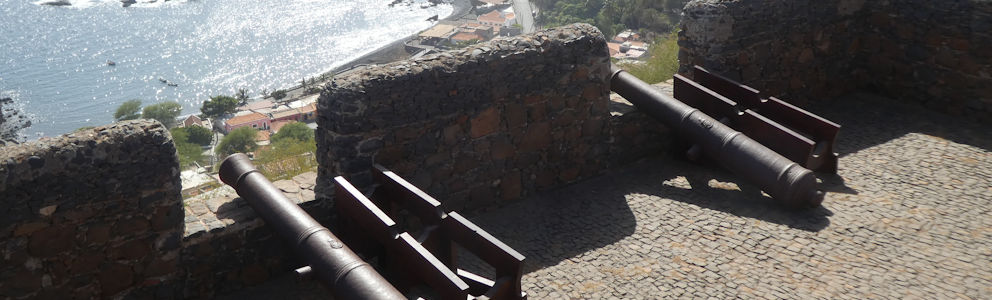
Now it mostly has souvenir shops. Behind the street is the oldest church in Cape Verde. The church was built by slaves, but they were not allowed to come here themselves. Alberto points to ruins on the rocks. That was the church for the slaves. The tour ends at the pillar on the Slave Market. On this square, slaves were once traded. Slaves were tied to the pillar so that potential buyers could inspect them well. Above the old town lies the fort. This is a Spanish fort. The Spaniards attacked the island in 1578. The Portuguese defense was no match for the Spaniards’ cannonballs. The Spaniards took over the town and built a new fortress on the top. From the walls of Forte Real de São Filipe, I see the valley where we walked. I also see the old town and the coastline. The fort is a beautiful place to end the walk. We get back into the van. In just under an hour, we drive to our overnight stay in the mountains. The driver drives above Praia and heads north. In São Domingos, he turns off. A narrow road climbs steeply into the mountains. At every bend, we get higher. Practically at the highest point lies our hotel Quinta Da Montanha. A beautiful place with a lovely view. It is clearly much cooler at this altitude. There is also a strong wind. Wearing a sweater and long pants, we walk past the few houses of Rui Vaz on the mountain ridge. Children greet us. Some stretch out their hands for money. The local travel agent has asked us not to give money to children. An activity is just starting in the church of the settlement. We cannot see exactly what. We leave it as it is. In the hotel’s restaurant, we order something to drink. The somewhat gloomy-looking restaurant has space for over a hundred people. This is probably because it is also a conference room, as there are not that many rooms. We move to the bar. It’s a bit warmer here. Our food is also served here: chicken, pork, and fish.
 Cape Verde
  Two boys see themselves in the photo
 Some boys are happy with a sultana
 The fresh fish is cleaned immediately
 As soon as the boat is on the beach sales begin
Travelogue The Islands of Cape Verde
Dag 2 | Cape Verde > The Plateau of Praia
Dag 3 | Cape Verde > The Shortest Flight Ever
Dag 4 | Cape Verde > Climbing the Fogo Volcano
Dag 5 | Cape Verde > Descending through the Misty Forest
Dag 6 | Cape Verde > The Historic Old Town
Dag 7 | Cape Verde > Serra Malagueta N.P.
Dag 8 | Cape Verde > The Market of Assomada
Dag 9 | Cape Verde > The Luggage Didn't Arrive