
154 countries
(and areas)
 - Belize
- Benin
- Bhutan
- Bolivia
- Bonaire
- Bosnia and Herzegovina
- Botswana
- Brazil
- British Virgin Islands
- Brunei
- Bulgaria
- Cambodia
- Canada
- Cape Verde
- Chile
- China
- Costa Rica
- Croatia
- Cuba
- Curacao
- Cyprus
- Czech Republic
- Denmark
- Dominica
- Dominican Republic
- Egypt
- El Salvador
- England
- Estonia
- Eswatini (Swaziland)
- Ethiopia
- Fiji
- Finland
- France
- French Guiana
- Georgia
- Germany
- Gibraltar
- Greece
- Grenada
- Guadeloupe
- Guatemala
- Honduras
- Hong Kong
- Hungary
- Iceland
- India
- Indonesia
- Iran
- Ireland
- Israel
- Italy
- Jamaica
- Japan
- Jordan
- Kazakhstan
- Kenya
- Kosovo
- Kuwait
- Kyrgyzstan
- Laos
- Latvia
- Lebanon
- Lesotho
- Liechtenstein
- Lithuania
- Luxembourg
- Macau
- Madagascar
- Malawi
- Malaysia
- Maldives
- Malta
- Martinique
- Mexico
- Moldova
- Monaco
- Mongolia
- Montenegro
- Morocco
- Mozambique
- Namibia
- Nepal
- Netherlands
- New Zealand
- Nicaragua
- North Macedonia
- Northern Ireland
- Norway
- Oman
- Pakistan
- Palestine
- Peru
- Philippines
- Poland
- Portugal
- Qatar
- Republic of Korea
- Romania
- Russia
- Saint Kitts and Nevis
- Saint Lucia
- Saint Martin
- Saint Vincent and the Grenadines
- San Marino
- São Tomé and Principe
- Saudi Arabia
- Scotland
- Senegal
- Serbia
- Singapore
- Sint Maarten
- Slovakia
- Slovenia
- South Africa
- Spain
- Sri Lanka
- Suriname
- Sweden
- Switzerland
- Tajikistan
- Tanzania
- Thailand
- The Gambia
- Tibet
- Togo
- Transnistria
- Trinidad and Tobago
- Tunisia
- Turkey
- Turkmenistan
- Uganda
- United Arab Emirates
- United States
- Uruguay
- Uzbekistan
- Vatican City
- Vietnam
- Wales
- Zambia
- Zanzibar
- Belize
- Benin
- Bhutan
- Bolivia
- Bonaire
- Bosnia and Herzegovina
- Botswana
- Brazil
- British Virgin Islands
- Brunei
- Bulgaria
- Cambodia
- Canada
- Cape Verde
- Chile
- China
- Costa Rica
- Croatia
- Cuba
- Curacao
- Cyprus
- Czech Republic
- Denmark
- Dominica
- Dominican Republic
- Egypt
- El Salvador
- England
- Estonia
- Eswatini (Swaziland)
- Ethiopia
- Fiji
- Finland
- France
- French Guiana
- Georgia
- Germany
- Gibraltar
- Greece
- Grenada
- Guadeloupe
- Guatemala
- Honduras
- Hong Kong
- Hungary
- Iceland
- India
- Indonesia
- Iran
- Ireland
- Israel
- Italy
- Jamaica
- Japan
- Jordan
- Kazakhstan
- Kenya
- Kosovo
- Kuwait
- Kyrgyzstan
- Laos
- Latvia
- Lebanon
- Lesotho
- Liechtenstein
- Lithuania
- Luxembourg
- Macau
- Madagascar
- Malawi
- Malaysia
- Maldives
- Malta
- Martinique
- Mexico
- Moldova
- Monaco
- Mongolia
- Montenegro
- Morocco
- Mozambique
- Namibia
- Nepal
- Netherlands
- New Zealand
- Nicaragua
- North Macedonia
- Northern Ireland
- Norway
- Oman
- Pakistan
- Palestine
- Peru
- Philippines
- Poland
- Portugal
- Qatar
- Republic of Korea
- Romania
- Russia
- Saint Kitts and Nevis
- Saint Lucia
- Saint Martin
- Saint Vincent and the Grenadines
- San Marino
- São Tomé and Principe
- Saudi Arabia
- Scotland
- Senegal
- Serbia
- Singapore
- Sint Maarten
- Slovakia
- Slovenia
- South Africa
- Spain
- Sri Lanka
- Suriname
- Sweden
- Switzerland
- Tajikistan
- Tanzania
- Thailand
- The Gambia
- Tibet
- Togo
- Transnistria
- Trinidad and Tobago
- Tunisia
- Turkey
- Turkmenistan
- Uganda
- United Arab Emirates
- United States
- Uruguay
- Uzbekistan
- Vatican City
- Vietnam
- Wales
- Zambia
- Zanzibar


Copyright 2004 - 2026
Veeronline.nl Travel Adventures

Home > Ethiopia > Tour through Mythical Ethiopia > Travelogue day 10
Travelogue Tour through Mythical Ethiopia
September 19 October 6 2012 (18 days)
Ethiopia > The rock churches of Lalibela
Dag 10 - Friday, September 28, 2012“From here, it’s still twelve kilometers,” says Anthony from behind the wheel of the Land Rover. “But from here, it gets very bumpy.” I am on my way to the Yemrehanna Kristo Church. This 11th-century church is located about 42 kilometers outside Lalibela. The first part of the road was fairly passable, with occasional loose stones and potholes. When Anthony turns off, the road becomes much worse. Driving a 4WD Land Rover is definitely not a luxury—it was originally planned to take a minibus, but I doubt such a vehicle could handle this road.

After an hour and a half, Anthony parks the Land Rover at the bottom of the staircase. I get out and begin the climb upward. After a few dozen meters, I pass the ticket office, which is still completely closed at this early hour. A woman from the village gestures that I can continue walking up. I think I understand that I can also buy a ticket at the top. I’ll see. The stone staircase leads me higher into the mountains. Along the way, I am overtaken by pilgrims. They are literally running up the mountain as if competing to see who reaches the top first. Only when I approach the final section—after more than fifteen minutes of walking—do I see the church. The church is built inside a cave. From above the rocks, sacred water flows down like a waterfall. I see pilgrims already washing under the cold stream. A priest meets me for the ticket. I explain that the ticket office below is closed. I can still buy a ticket from him. I follow him into the cave. I look upon two magnificent structures, both made of alternating layers of stone and wood. On the left is the old church, and on the right, the former palace. I follow the priest into the church. He shows me the frescoes and wooden inscriptions—beautiful! He then points to the back of the cave, where numerous skeletons are stacked.
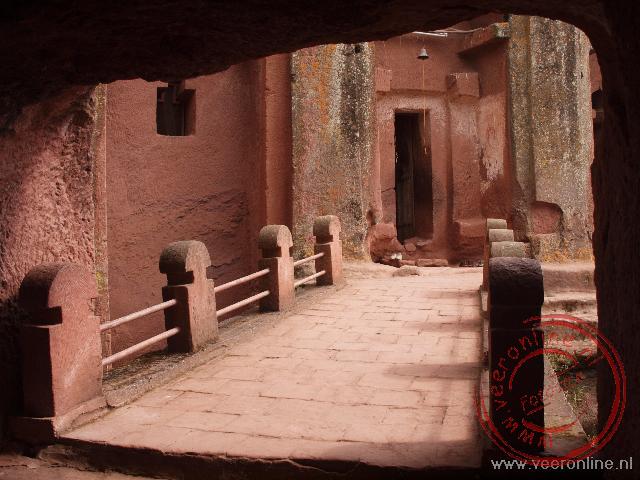
According to legend, they belong to thousands of pilgrims. It is a bizarre sight to see all these bones laid out. The old palace is used as storage, with little to see inside. Around the church, it grows busier and busier with pilgrims. It is a good moment to depart. I thank the priest and begin the descent. Anthony brings me home safely and quickly. In the afternoon, I visit the second group of rock churches in Lalibela, located on the other side of the constructed Jordan River. The first church is the Bet Gabriel-Rufael Church. It was originally a palace; later, it became a church. Because of this, the church is surrounded by a deep moat. A bridge leads me into the church, which is also the only one not oriented to the east. Through a small tunnel, I reach Mount Bethlehem—a circular hollowed-out structure. From here, a 25-meter-long dark tunnel leads to the next church. I am glad I brought my flashlight. I emerge at the Bet Merkorios Church. All the churches are connected by gates, tunnels, and narrow stairways. Sometimes I walk along a narrow path between two rock walls. It is fun to move between the churches this way.
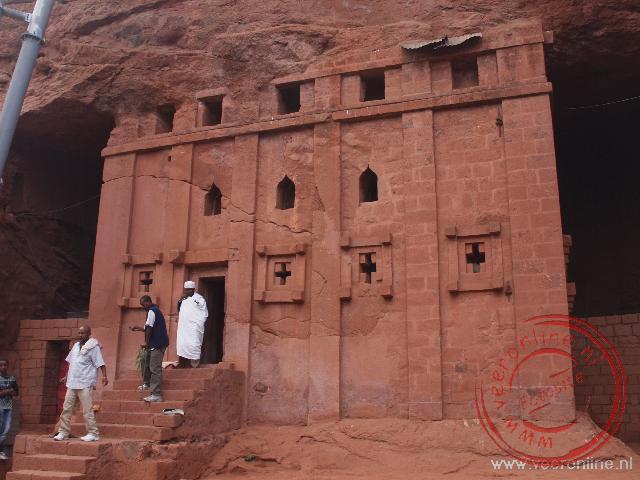
I arrive at the Bet Amanuel Church, a completely free-standing church beautifully carved from the rock. Clean horizontal and vertical lines adorn the church’s façade. The interior details are equally stunning. Asschef proudly tells me this is his favorite church. He is training to become a priest here. I conclude the tour at the Bet Abba Libanos Church, built into the rock face. Above the church rests the remaining rock. From the very small church, when I exit through the side entrance, I see that the church is fully carved out all around, with only the roof connected to the overlying rock. A magnificent example to end the tour. I then prepare for a typical Ethiopian tradition: the coffee ceremony. At a guesthouse in Lalibela, I am welcomed for the ceremony. The coffee is roasted, finely ground, and boiled with water. While the process is underway, bowls of popcorn and a type of hard chips are passed around. Tej and Arak drinks are also served. The coffee tastes wonderfully smooth. It is no wonder Ethiopians say that coffee originates from their country.
 Ethiopia
  Vultures feast on a cow hit by a vehicle
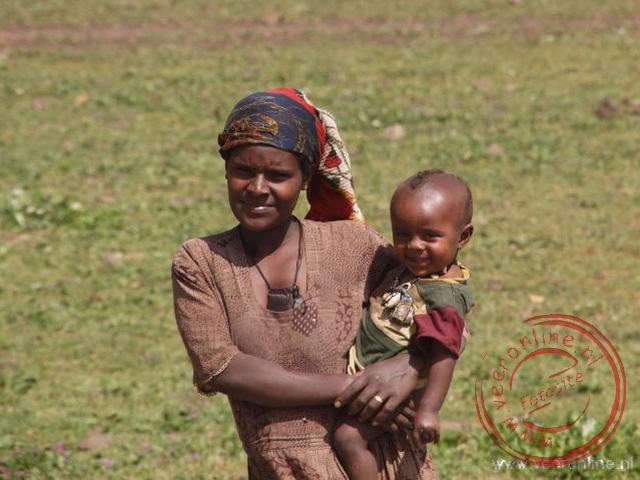 A woman looks up briefly during her work in the fields
 The old Portuguese bridge in Bahir Dar
 The interior of the Bet Medhane Alem rock church
Travelogue Tour through Mythical Ethiopia
Dag 2 | Ethiopia > City tour through Addis Ababa
Dag 3 | Ethiopia > Traveling through green Ethiopia
Dag 4 | Ethiopia > The Nile Falls and Lake Tana
Dag 5 | Ethiopia > The palaces of Gondar
Dag 6 | Ethiopia > Hiking in the Semien Mountains
Dag 7 | Ethiopia > Visit to Grace Village orphanage
Dag 8 | Ethiopia > The stelae of Axum
Dag 9 | Ethiopia > 'Happy Meskel!”
Dag 10 | Ethiopia > The rock churches of Lalibela
Dag 11 | Ethiopia > Flight back to Addis Ababa
Dag 12 | Ethiopia > Heavy rainfall near Aragash
Dag 13 | Ethiopia > Delivering a gift in Arba Minch
Dag 14 | Ethiopia > Visiting the Dorze tribe
Dag 15 | Ethiopia > On the way to Lake Langano
Dag 16 | Ethiopia > Langano Vacation Club Resort
Dag 17 | Ethiopia > Back to Addis, back home
Dag 18 | Ethiopia > Farewell to Ethiopia