
154 countries
(and areas)
 - Belize
- Benin
- Bhutan
- Bolivia
- Bonaire
- Bosnia and Herzegovina
- Botswana
- Brazil
- British Virgin Islands
- Brunei
- Bulgaria
- Cambodia
- Canada
- Cape Verde
- Chile
- China
- Costa Rica
- Croatia
- Cuba
- Curacao
- Cyprus
- Czech Republic
- Denmark
- Dominica
- Dominican Republic
- Egypt
- El Salvador
- England
- Estonia
- Eswatini (Swaziland)
- Ethiopia
- Fiji
- Finland
- France
- French Guiana
- Georgia
- Germany
- Gibraltar
- Greece
- Grenada
- Guadeloupe
- Guatemala
- Honduras
- Hong Kong
- Hungary
- Iceland
- India
- Indonesia
- Iran
- Ireland
- Israel
- Italy
- Jamaica
- Japan
- Jordan
- Kazakhstan
- Kenya
- Kosovo
- Kuwait
- Kyrgyzstan
- Laos
- Latvia
- Lebanon
- Lesotho
- Liechtenstein
- Lithuania
- Luxembourg
- Macau
- Madagascar
- Malawi
- Malaysia
- Maldives
- Malta
- Martinique
- Mexico
- Moldova
- Monaco
- Mongolia
- Montenegro
- Morocco
- Mozambique
- Namibia
- Nepal
- Netherlands
- New Zealand
- Nicaragua
- North Macedonia
- Northern Ireland
- Norway
- Oman
- Pakistan
- Palestine
- Peru
- Philippines
- Poland
- Portugal
- Qatar
- Republic of Korea
- Romania
- Russia
- Saint Kitts and Nevis
- Saint Lucia
- Saint Martin
- Saint Vincent and the Grenadines
- San Marino
- São Tomé and Principe
- Saudi Arabia
- Scotland
- Senegal
- Serbia
- Singapore
- Sint Maarten
- Slovakia
- Slovenia
- South Africa
- Spain
- Sri Lanka
- Suriname
- Sweden
- Switzerland
- Tajikistan
- Tanzania
- Thailand
- The Gambia
- Tibet
- Togo
- Transnistria
- Trinidad and Tobago
- Tunisia
- Turkey
- Turkmenistan
- Uganda
- United Arab Emirates
- United States
- Uruguay
- Uzbekistan
- Vatican City
- Vietnam
- Wales
- Zambia
- Zanzibar
- Belize
- Benin
- Bhutan
- Bolivia
- Bonaire
- Bosnia and Herzegovina
- Botswana
- Brazil
- British Virgin Islands
- Brunei
- Bulgaria
- Cambodia
- Canada
- Cape Verde
- Chile
- China
- Costa Rica
- Croatia
- Cuba
- Curacao
- Cyprus
- Czech Republic
- Denmark
- Dominica
- Dominican Republic
- Egypt
- El Salvador
- England
- Estonia
- Eswatini (Swaziland)
- Ethiopia
- Fiji
- Finland
- France
- French Guiana
- Georgia
- Germany
- Gibraltar
- Greece
- Grenada
- Guadeloupe
- Guatemala
- Honduras
- Hong Kong
- Hungary
- Iceland
- India
- Indonesia
- Iran
- Ireland
- Israel
- Italy
- Jamaica
- Japan
- Jordan
- Kazakhstan
- Kenya
- Kosovo
- Kuwait
- Kyrgyzstan
- Laos
- Latvia
- Lebanon
- Lesotho
- Liechtenstein
- Lithuania
- Luxembourg
- Macau
- Madagascar
- Malawi
- Malaysia
- Maldives
- Malta
- Martinique
- Mexico
- Moldova
- Monaco
- Mongolia
- Montenegro
- Morocco
- Mozambique
- Namibia
- Nepal
- Netherlands
- New Zealand
- Nicaragua
- North Macedonia
- Northern Ireland
- Norway
- Oman
- Pakistan
- Palestine
- Peru
- Philippines
- Poland
- Portugal
- Qatar
- Republic of Korea
- Romania
- Russia
- Saint Kitts and Nevis
- Saint Lucia
- Saint Martin
- Saint Vincent and the Grenadines
- San Marino
- São Tomé and Principe
- Saudi Arabia
- Scotland
- Senegal
- Serbia
- Singapore
- Sint Maarten
- Slovakia
- Slovenia
- South Africa
- Spain
- Sri Lanka
- Suriname
- Sweden
- Switzerland
- Tajikistan
- Tanzania
- Thailand
- The Gambia
- Tibet
- Togo
- Transnistria
- Trinidad and Tobago
- Tunisia
- Turkey
- Turkmenistan
- Uganda
- United Arab Emirates
- United States
- Uruguay
- Uzbekistan
- Vatican City
- Vietnam
- Wales
- Zambia
- Zanzibar


Copyright 2004 - 2026
Veeronline.nl Travel Adventures

Home > Belgium > Historic Brussels > Travelogue day 1
Travelogue Historic Brussels
July 25 2020 (4 days)
Belgium > The Koekelberg Basilica
Dag 1 - Thursday 2 July 2020After eight months, I cross the border for the first time again—this time for a city trip to the Belgian capital, Brussels. Travel hadn’t been possible earlier due to COVID. Nicolette and I drive to Brussels in about two hours. Along the way, there is little sign of virus restrictions. Traffic is even quite heavy on the Antwerp Ring. Without much delay, we arrive around eleven o’clock at the impressive Koekelberg Basilica. The basilica is the fifth largest church in the world. From a distance, I can already see the enormous building. Because the Koekelberg Basilica is built on a hill, it appears even larger. Finding a parking spot near the basilica is not easy. Construction work is taking place, and the entrance indicated by the navigation system is closed. We drive an extra round around the church. To reach the parking lot, we must drive a short distance against the traffic flow—or at least it feels that way.

Due to COVID, we had reserved a time slot for our visit in advance. We are warmly welcomed at the tourist desk. Construction of the basilica began in 1905 and lasted an astonishing 73 years. Often, work could only continue once additional funding became available. Inside, the basilica is enormous. The often-donated stained-glass windows make the interior especially remarkable. Otherwise, of course, it is a relatively modern church. We take the lift to the panoramic roof. From the walkway around the dome, at a height of 53 meters, we look out over the city of Brussels. On one side, the Atomium rises above the buildings; on the other side is the city center. In the distance, we can see the Town Hall tower. After the visit, we drive further into the city toward our hotel. Due to roadworks, traffic moves frustratingly slowly. The navigation indicates 18 minutes travel time for just three kilometers. In the center, we park in the Schandknaap parking garage, near the Grand Place. From there, it is only a few minutes’ walk to our hotel, just behind the Beurs building. The hotel is located above a café. The bartender also handles the reception for hotel guests. She gives us the key to room one. With a small and seemingly unreliable lift, we go to the first floor—there is no staircase. We arrive in a comfortable room, which will serve as a perfect base for exploring Brussels over the next few days. We leave the hotel and walk into the city center. Streets are lined with cozy terraces. Many restaurants invite us to sit outside, probably because they have few customers. In the Royal Saint Hubert Galleries, we order a sandwich—much needed after the journey. This elegant passage, opened in 1847, was meant to give the district more flair. After lunch, we continue through the center and arrive at the Grand Place. The beautiful Town Hall dominates the square with its tall tower. Opposite the Town Hall is the former Bread House, a magnificent Gothic building, which now houses the Brussels Museum. Other buildings, mainly former guild houses, complement the square beautifully. Each of these houses is splendidly decorated with golden statues and inscriptions, making the Grand Place a truly remarkable location.
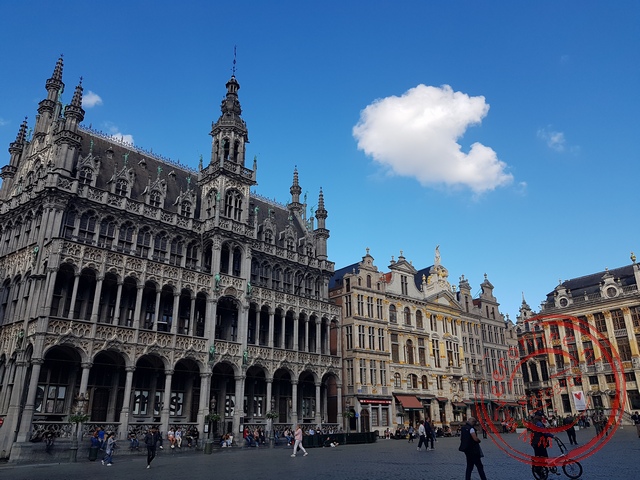
Around three o’clock, we arrive at the St. Michael and St. Gudula Cathedral. Lut is waiting for us at the entrance. She gives us a private tour of the cathedral and the underlying crypt. Outside, she points out the statues on the façade. The details she highlights are especially interesting. Lut explains that the higher statues sometimes have unusual forms. She believes these were jokes by the artists, since patrons could not see them at that height. After a circuit around the church, we go inside with her. Lut tells us the church was severely damaged during the Beeldenstorm in 1566. She jokingly adds, a little reproachfully, “when you came here,” referring to Protestants plundering southwards from the Netherlands. Fortunately, she does not take it personally. The Beeldenstorm indirectly triggered the outbreak of the Eighty Years’ War and the formation of the Republic of the Seven United Netherlands. With great enthusiasm, Lut tells us about Saint Gudula of Brussels, who in the fifth century cared for the weak and sick. Saint Michael is the archangel and the patron saint of the city of Brussels.

Lut shows us the statues, paintings, and beautiful stained-glass windows in the cathedral. In the Romanesque crypt beneath the cathedral is presumably the tomb of the brother of Archduke Albert VII of Austria. He and his wife Isabelle are buried in a side chapel. After visiting the treasury, with its beautifully gilded chalices and relics, we say goodbye to Lut and thank her for the nearly two-hour tour and her extremely interesting explanations. It is time for a drink. We settle on one of the terraces for a beer and a glass of wine. At the end of the afternoon, we return to Greepstraat, where we had parked the car this morning. We have a restaurant reservation here. Due to COVID, it was advised to book in advance. Based on the number of restaurants and their low occupancy, this seems unnecessary for the coming days. Instead of a menu, we receive a card with a QR code, which allows us to load the menu on our phones. Convenient for the restaurant, but it doesn’t work for us. Reluctantly, the waiter provides a physical menu.
 Belgium
 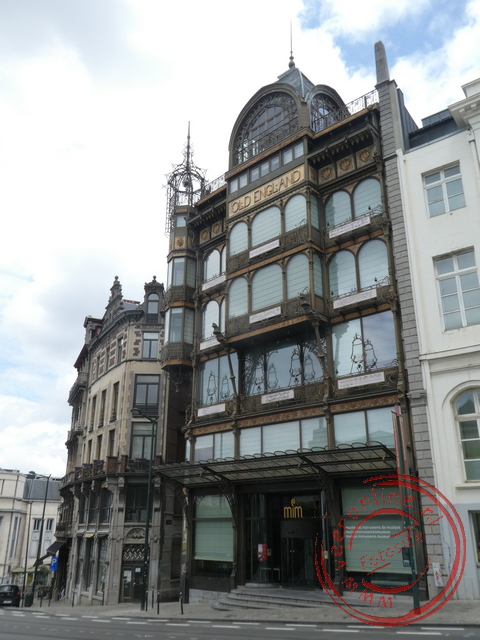 The Old England department store from 1899
 The statue of the stadtholders Hoorne and van Egmont
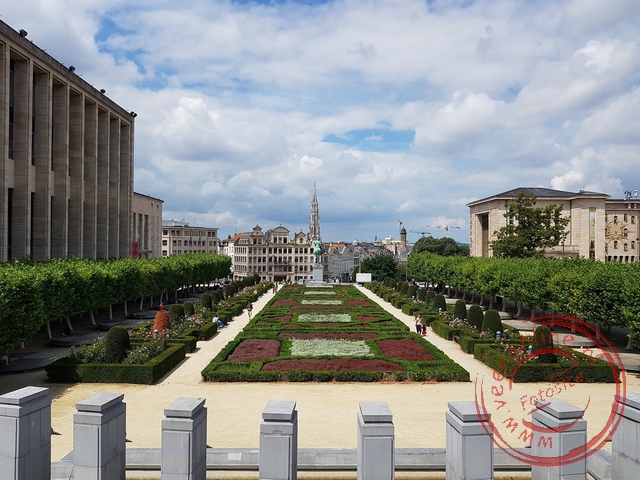 The park on the Mont des Arts
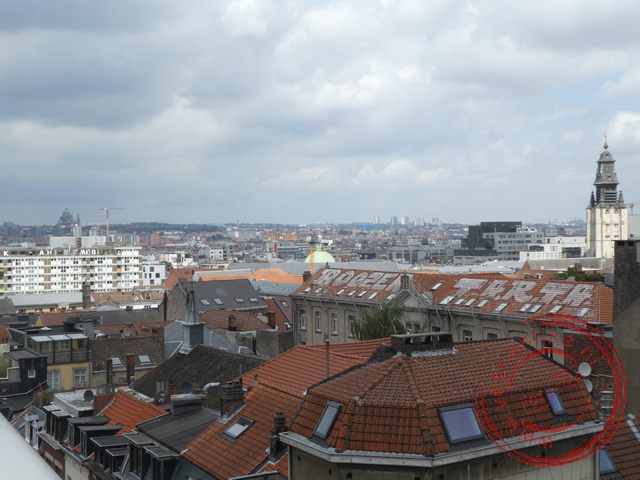 Viewpoint near the Palace of Justice
Travelogue Historic Brussels
Dag 2 | Belgium > Guided Tour of Brussels
Dag 3 | Belgium > The European Quarter
Dag 4 | Belgium > Inside the Atomium