
154 countries
(and areas)
 - Belize
- Benin
- Bhutan
- Bolivia
- Bonaire
- Bosnia and Herzegovina
- Botswana
- Brazil
- British Virgin Islands
- Brunei
- Bulgaria
- Cambodia
- Canada
- Cape Verde
- Chile
- China
- Costa Rica
- Croatia
- Cuba
- Curacao
- Cyprus
- Czech Republic
- Denmark
- Dominica
- Dominican Republic
- Egypt
- El Salvador
- England
- Estonia
- Eswatini (Swaziland)
- Ethiopia
- Fiji
- Finland
- France
- French Guiana
- Georgia
- Germany
- Gibraltar
- Greece
- Grenada
- Guadeloupe
- Guatemala
- Honduras
- Hong Kong
- Hungary
- Iceland
- India
- Indonesia
- Iran
- Ireland
- Israel
- Italy
- Jamaica
- Japan
- Jordan
- Kazakhstan
- Kenya
- Kosovo
- Kuwait
- Kyrgyzstan
- Laos
- Latvia
- Lebanon
- Lesotho
- Liechtenstein
- Lithuania
- Luxembourg
- Macau
- Madagascar
- Malawi
- Malaysia
- Maldives
- Malta
- Martinique
- Mexico
- Moldova
- Monaco
- Mongolia
- Montenegro
- Morocco
- Mozambique
- Namibia
- Nepal
- Netherlands
- New Zealand
- Nicaragua
- North Macedonia
- Northern Ireland
- Norway
- Oman
- Pakistan
- Palestine
- Peru
- Philippines
- Poland
- Portugal
- Qatar
- Republic of Korea
- Romania
- Russia
- Saint Kitts and Nevis
- Saint Lucia
- Saint Martin
- Saint Vincent and the Grenadines
- San Marino
- São Tomé and Principe
- Saudi Arabia
- Scotland
- Senegal
- Serbia
- Singapore
- Sint Maarten
- Slovakia
- Slovenia
- South Africa
- Spain
- Sri Lanka
- Suriname
- Sweden
- Switzerland
- Tajikistan
- Tanzania
- Thailand
- The Gambia
- Tibet
- Togo
- Transnistria
- Trinidad and Tobago
- Tunisia
- Turkey
- Turkmenistan
- Uganda
- United Arab Emirates
- United States
- Uruguay
- Uzbekistan
- Vatican City
- Vietnam
- Wales
- Zambia
- Zanzibar
- Belize
- Benin
- Bhutan
- Bolivia
- Bonaire
- Bosnia and Herzegovina
- Botswana
- Brazil
- British Virgin Islands
- Brunei
- Bulgaria
- Cambodia
- Canada
- Cape Verde
- Chile
- China
- Costa Rica
- Croatia
- Cuba
- Curacao
- Cyprus
- Czech Republic
- Denmark
- Dominica
- Dominican Republic
- Egypt
- El Salvador
- England
- Estonia
- Eswatini (Swaziland)
- Ethiopia
- Fiji
- Finland
- France
- French Guiana
- Georgia
- Germany
- Gibraltar
- Greece
- Grenada
- Guadeloupe
- Guatemala
- Honduras
- Hong Kong
- Hungary
- Iceland
- India
- Indonesia
- Iran
- Ireland
- Israel
- Italy
- Jamaica
- Japan
- Jordan
- Kazakhstan
- Kenya
- Kosovo
- Kuwait
- Kyrgyzstan
- Laos
- Latvia
- Lebanon
- Lesotho
- Liechtenstein
- Lithuania
- Luxembourg
- Macau
- Madagascar
- Malawi
- Malaysia
- Maldives
- Malta
- Martinique
- Mexico
- Moldova
- Monaco
- Mongolia
- Montenegro
- Morocco
- Mozambique
- Namibia
- Nepal
- Netherlands
- New Zealand
- Nicaragua
- North Macedonia
- Northern Ireland
- Norway
- Oman
- Pakistan
- Palestine
- Peru
- Philippines
- Poland
- Portugal
- Qatar
- Republic of Korea
- Romania
- Russia
- Saint Kitts and Nevis
- Saint Lucia
- Saint Martin
- Saint Vincent and the Grenadines
- San Marino
- São Tomé and Principe
- Saudi Arabia
- Scotland
- Senegal
- Serbia
- Singapore
- Sint Maarten
- Slovakia
- Slovenia
- South Africa
- Spain
- Sri Lanka
- Suriname
- Sweden
- Switzerland
- Tajikistan
- Tanzania
- Thailand
- The Gambia
- Tibet
- Togo
- Transnistria
- Trinidad and Tobago
- Tunisia
- Turkey
- Turkmenistan
- Uganda
- United Arab Emirates
- United States
- Uruguay
- Uzbekistan
- Vatican City
- Vietnam
- Wales
- Zambia
- Zanzibar


Copyright 2004 - 2026
Veeronline.nl Travel Adventures
Home > Benin > Under the Spell of Voodoo > Travelogue day 16
Travelogue Under the Spell of Voodoo
December 21 2010 January 12 2011 (23 days)
Benin > Visit to the palace of Abomey
Dag 16 - Wednesday, January 5, 2011Abomey is a city in the Zou district and was formerly the capital of the Kingdom of Dahomey. The royal palaces of Abomey were built by the Fon people between 1600 and 1900. These palaces are also part of the UNESCO World Heritage list. Each king built his palace right next to that of his predecessor. In total, the Abomey dynasty had twelve kings, meaning there were twelve palaces built side by side.

Each palace was surrounded by a mud wall topped with thorny acacia trees. Inside the walls are several royal palaces, a marketplace, sacrificial sites, and barracks. The wealth of the Abomey kingdom came from the slave trade. Abomey traded local slaves with the Portuguese in exchange for weapons and money. In 1892, under King Behanzin, the Abomey dynasty came to an end. Abomey was conquered by French colonial troops. Behanzin set fire to the city and fled. Only the palaces of Glèlè and Guézo survived and have since been restored. The former bas-reliefs in the walls, depicting the power of the Fon people, have also been restored. Formally, Abomey still has a king, but this is now only a ceremonial role. The king no longer resides in the restored palaces, which are now open as museums. When we arrive in Abomey by bus, we first stop at the statue of King Béhanzin. The statue, located in Goho Place park, honors the king for his courageous struggle against the French troops. The monument, partly due to its size, makes an impressive impression. However, it is odd to see so much litter around the statue—a messy sight.

At the entrance to the palace, we are welcomed by Francoise, our museum guide. Unfortunately, she informs us that photography is not allowed. We begin in the courtyard of Glèlè’s palace, a large open space with a big tree in the center. Nothing indicates that this is a palace. Surrounding the courtyard are mud buildings; on the left are souvenir shops. The building on the right, the Jonnonho, used to be the reception room, where twelve staffs of the kings stand, each bearing its own symbol or animal. Through a passage in the wall, we enter a second courtyard, which was reserved exclusively for the royal family. Here is also the voodoo temple, though it is too low to view the interior. We visit several buildings while Francoise explains the displayed collection. At Glèlè’s tomb lies the grave of 41 women who voluntarily confined themselves to continue serving the king after his death—the number 41 being sacred. Directly behind this is Glèlè’s own tomb. I remove my sandals and enter the tomb barefoot. Inside is an old bed where the king’s spirit may rest.

Guézo’s palace is laid out in a similar way, and we visit the buildings there as well. Here, we can enter the voodoo temple. Eventually, we return to the souvenir shops and exit the palace. Back at the hotel, I take a swim in the pool, which is fairly large and notably deep—perfect for a few laps. In the afternoon, we drive to Cové, about 30 kilometers east of Bohicon. Upon entering Cové, we are welcomed by the mayor, who leads the way in his car. Along the sandy roads, Abass climbs onto the roof to push low-hanging power lines upward, but one snaps. We complete the final stretch on foot, accompanied by local children. In one of the town’s neighborhoods, a Guèlèdè mask dance is performed for us. Under a large tree on a sandy square, thirteen chairs are set out for us. The drum music starts immediately. I am quickly surrounded by curious children. The mask dance is part of the voodoo culture, and I watch what unfolds. The children behind me enjoy seeing the photos on my camera screen. It is oppressively hot, and everyone is tightly packed. Over a hundred local spectators crowd to watch—both children and adults. An elderly woman sprinkles water on the sand to suppress the dust. From a corner, the first dancer appears, wearing a mask. Each Guèlèdè mask represents a particular situation, with moving parts controlled by strings. The dancers also wear iron rings around their ankles that chime rhythmically with the dance. Various masks are paraded. When the audience grows restless, a dancer appears with a humorously sexualized mask, prompting laughs. From towering masks to a dancing haystack, everything is presented, from a wolf to a dancing table. After an hour and a half, the performance ends. We say goodbye and return to Bohicon. When I collect my laundry at the reception, everything is mixed up. I gather my belongings, and the accompanying bill cannot be correct. After some back-and-forth discussion, I pay half—it will probably be roughly right.
 Benin
Benin  The king of the Voodoo during the Benin festival
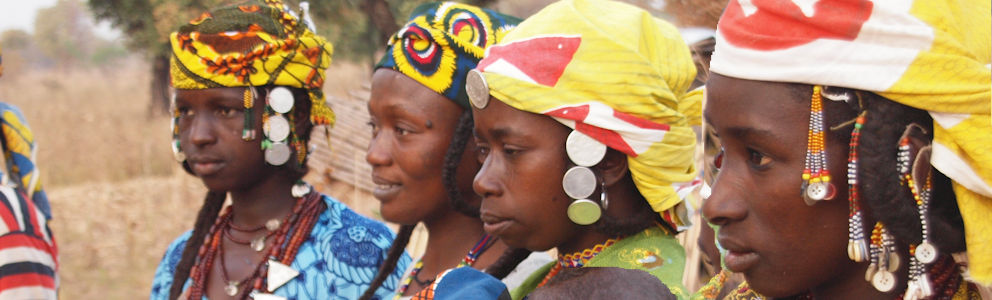
 Despite their nomadic life the women dress beautifully not just for the photo
 A Voodoo offering site in the village of Hewe near Grand Popo
 The masks depict different situations during the dance
Travelogue Under the Spell of Voodoo
Dag 2 | Togo > Getting to know the city of Lomé
Dag 3 | Togo > The voodoo priest and the voodoo ceremony
Dag 4 | Togo > A dance performance on Christmas Eve
Dag 5 | Togo > 'Jové, Jové”
Dag 6 | Togo > The fire dance of the Tem tribe
Dag 7 | Togo > The iron blast furnaces of Bangeli
Dag 8 | Togo > Walking tour through Djamdé
Dag 9 | Togo > Climbing Mount Kabyé
Dag 10 | Togo > A Djembe as a souvenir
Dag 11 | Benin > New Year's Eve among the Beninese
Dag 12 | Benin > A look at the Somba tribes
Dag 13 | Benin > Meeting the chief of the Taneka-Beri tribe
Dag 14 | Benin > Singing with the children in Moupemou
Dag 15 | Benin > From north to south Benin
Dag 16 | Benin > Visit to the palace of Abomey
Dag 17 | Benin > The King of Ketou
Dag 18 | Benin > Sleeping in a stilt house in Ganvié
Dag 19 | Benin > Slave route to the 'Door of No Return'
Dag 20 | Benin > Eating a local pizza in the dark
Dag 21 | Benin > Voodoo festival of Quidah
Dag 22 | Togo > Farewell to Lomé
Dag 23 | Togo > Does the Djembe fit or not?