
154 countries
(and areas)
 - Belize
- Benin
- Bhutan
- Bolivia
- Bonaire
- Bosnia and Herzegovina
- Botswana
- Brazil
- British Virgin Islands
- Brunei
- Bulgaria
- Cambodia
- Canada
- Cape Verde
- Chile
- China
- Costa Rica
- Croatia
- Cuba
- Curacao
- Cyprus
- Czech Republic
- Denmark
- Dominica
- Dominican Republic
- Egypt
- El Salvador
- England
- Estonia
- Eswatini (Swaziland)
- Ethiopia
- Fiji
- Finland
- France
- French Guiana
- Georgia
- Germany
- Gibraltar
- Greece
- Grenada
- Guadeloupe
- Guatemala
- Honduras
- Hong Kong
- Hungary
- Iceland
- India
- Indonesia
- Iran
- Ireland
- Israel
- Italy
- Jamaica
- Japan
- Jordan
- Kazakhstan
- Kenya
- Kosovo
- Kuwait
- Kyrgyzstan
- Laos
- Latvia
- Lebanon
- Lesotho
- Liechtenstein
- Lithuania
- Luxembourg
- Macau
- Madagascar
- Malawi
- Malaysia
- Maldives
- Malta
- Martinique
- Mexico
- Moldova
- Monaco
- Mongolia
- Montenegro
- Morocco
- Mozambique
- Namibia
- Nepal
- Netherlands
- New Zealand
- Nicaragua
- North Macedonia
- Northern Ireland
- Norway
- Oman
- Pakistan
- Palestine
- Peru
- Philippines
- Poland
- Portugal
- Qatar
- Republic of Korea
- Romania
- Russia
- Saint Kitts and Nevis
- Saint Lucia
- Saint Martin
- Saint Vincent and the Grenadines
- San Marino
- São Tomé and Principe
- Saudi Arabia
- Scotland
- Senegal
- Serbia
- Singapore
- Sint Maarten
- Slovakia
- Slovenia
- South Africa
- Spain
- Sri Lanka
- Suriname
- Sweden
- Switzerland
- Tajikistan
- Tanzania
- Thailand
- The Gambia
- Tibet
- Togo
- Transnistria
- Trinidad and Tobago
- Tunisia
- Turkey
- Turkmenistan
- Uganda
- United Arab Emirates
- United States
- Uruguay
- Uzbekistan
- Vatican City
- Vietnam
- Wales
- Zambia
- Zanzibar
- Belize
- Benin
- Bhutan
- Bolivia
- Bonaire
- Bosnia and Herzegovina
- Botswana
- Brazil
- British Virgin Islands
- Brunei
- Bulgaria
- Cambodia
- Canada
- Cape Verde
- Chile
- China
- Costa Rica
- Croatia
- Cuba
- Curacao
- Cyprus
- Czech Republic
- Denmark
- Dominica
- Dominican Republic
- Egypt
- El Salvador
- England
- Estonia
- Eswatini (Swaziland)
- Ethiopia
- Fiji
- Finland
- France
- French Guiana
- Georgia
- Germany
- Gibraltar
- Greece
- Grenada
- Guadeloupe
- Guatemala
- Honduras
- Hong Kong
- Hungary
- Iceland
- India
- Indonesia
- Iran
- Ireland
- Israel
- Italy
- Jamaica
- Japan
- Jordan
- Kazakhstan
- Kenya
- Kosovo
- Kuwait
- Kyrgyzstan
- Laos
- Latvia
- Lebanon
- Lesotho
- Liechtenstein
- Lithuania
- Luxembourg
- Macau
- Madagascar
- Malawi
- Malaysia
- Maldives
- Malta
- Martinique
- Mexico
- Moldova
- Monaco
- Mongolia
- Montenegro
- Morocco
- Mozambique
- Namibia
- Nepal
- Netherlands
- New Zealand
- Nicaragua
- North Macedonia
- Northern Ireland
- Norway
- Oman
- Pakistan
- Palestine
- Peru
- Philippines
- Poland
- Portugal
- Qatar
- Republic of Korea
- Romania
- Russia
- Saint Kitts and Nevis
- Saint Lucia
- Saint Martin
- Saint Vincent and the Grenadines
- San Marino
- São Tomé and Principe
- Saudi Arabia
- Scotland
- Senegal
- Serbia
- Singapore
- Sint Maarten
- Slovakia
- Slovenia
- South Africa
- Spain
- Sri Lanka
- Suriname
- Sweden
- Switzerland
- Tajikistan
- Tanzania
- Thailand
- The Gambia
- Tibet
- Togo
- Transnistria
- Trinidad and Tobago
- Tunisia
- Turkey
- Turkmenistan
- Uganda
- United Arab Emirates
- United States
- Uruguay
- Uzbekistan
- Vatican City
- Vietnam
- Wales
- Zambia
- Zanzibar


Copyright 2004 - 2026
Veeronline.nl Travel Adventures

Home > Australia > Tour of Australia > Travelogue day 21
Travelogue Tour of Australia
December 9 2023 January 6 2024 (29 days)
Australia > Aboriginal rock art in Kakadu
Dag 21 - Friday, 29 December 2023This morning we have time to explore Darwin. By about half past eight, it’s already oppressively warm outside. I need to get used to this. Across the street, we order coffee and a croissant. At a relaxed walking pace, we then head to the Waterfront. The Waterfront is the harbor area of Darwin. Nowadays, it houses several bars and restaurants. There are also modern apartment complexes. We take the public lift down to the lower harbor area. Along the coast is a wave pool. Because of the presence of saltwater crocodiles, swimming in the sea is dangerous. Part of the harbor is separated from the sea by a pier. Here are various play structures for children. Nobody is using them—probably it’s either too early or too hot. My polo shirt is already getting quite wet. We walk past a tunnel museum. During World War II, the Australians built tunnels in the hills to store ammunition. The Japanese regularly bombed the city. We walk through the two-hundred-meter-long tunnel. Along the sides, the history of Darwin is explained. By late morning, we return to the hotel. The oppressive heat is exhausting. I’m a bit worried about the walks planned for this afternoon.

At noon, Ann drives the bus up again. We leave Darwin via the Stuart Highway, this time heading towards Adelaide. After just a few dozen kilometers, we turn off and continue along the Arnhem Highway. The Arnhem was one of the first Dutch ships to visit Australia and is named after the Dutch city. On both sides of the road are wallabies. One wallaby just barely crosses the road in front of the bus. Only by braking sharply does Ann avoid hitting the animal. We stop at the Fogg Dam Conservation Reserve. The Fogg Dam lies in the floodplains of the Adelaide River. It is an important bird area. As we slowly drive over the dam, we see lotus plants in a shallow layer of water on the left and dry grassland on the right. Some Magpie Geese graze among the grass. Birds are sitting in the trees but are hiding in the shade of the leaves. It’s hot for them as well. Ann spots a kingfisher in the trees, but it flies away before I can see it. Around this time, most animals hide away. Even at the viewpoint, I only see the geese. A birdwatcher with a large telephoto lens sighs that some children just scared all the birds away. After Fogg Dam, we continue on to Kakadu National Park. A huge nature reserve, about half the size of the Netherlands. The park was established in 1981 in a collaboration between the Australian government and the original Aboriginal population. The name is derived from the Aboriginal word “Gagudju.” We pass several rivers in the park. Ann points out that the water is high due to recent rainfall. She also emphasizes that falling into the river is almost always fatal because of the presence of crocodiles. Both freshwater and saltwater crocodiles live in this area. Due to the high water level, not all roads are passable. The road to the Aboriginal rock paintings at Ubirr is impassable. We therefore visit an alternative rock art site. While driving through Kakadu National Park, we see beautiful wetlands. Various birds reside in this area. Near Jabiru, we turn south. At the roadhouse at the junction, we take a break. The roadhouse also keeps two crocodiles and two water buffalo. Water buffalo were introduced in the 19th century but have grown to a population of 350,000 animals. In recent years, the number is being reduced because the buffalo originally do not belong here and have no natural enemies. Nawurlandja Mountain was an important place for the Aboriginals. The mountain is now deserted, but the rock paintings remind us of their former presence.
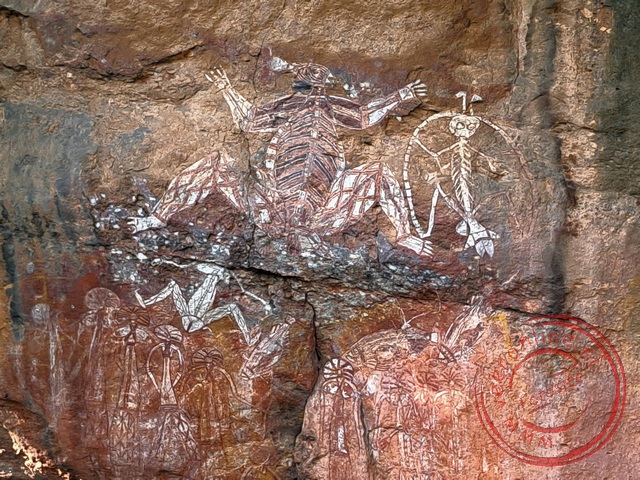
The moment we step out, flies appear again. They thrive well in the humid heat. Today it may be only 35 degrees Celsius, but the apparent temperature is ten degrees higher. As I walk toward the rocks, I pull my fly net over my head. The rock paintings date from various periods. Some are thousands of years old. Others were added halfway through the last century. The X-ray paintings—images showing animals and humans only with their bones—are remarkable. Today, it is important to drink enough. I set aside the fly net and take a sip. Although it’s hot, I still climb the last stretch to the lookout point at Nawurlandja Lookout. The sun is already low on the horizon when we arrive around half past six at the Coounda Lodge in Kakadu National Park. In the restaurant, I order a kangaroo burger and a large glass of beer. All food and drinks must be brought into the park, so prices here reflect that.
 Australia
 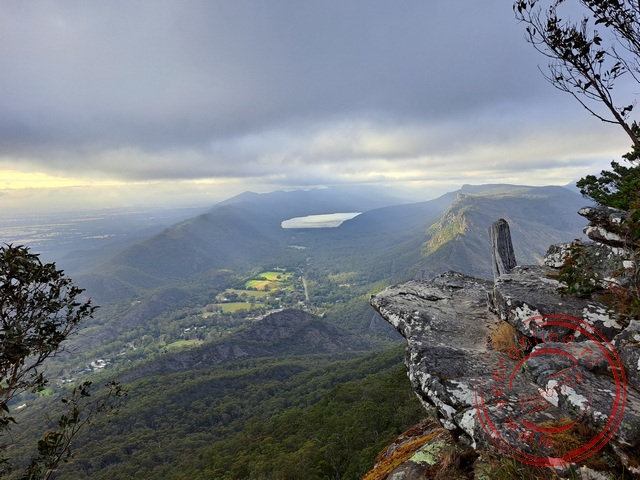 A beautiful view from the Boroka lookout in the Grampians
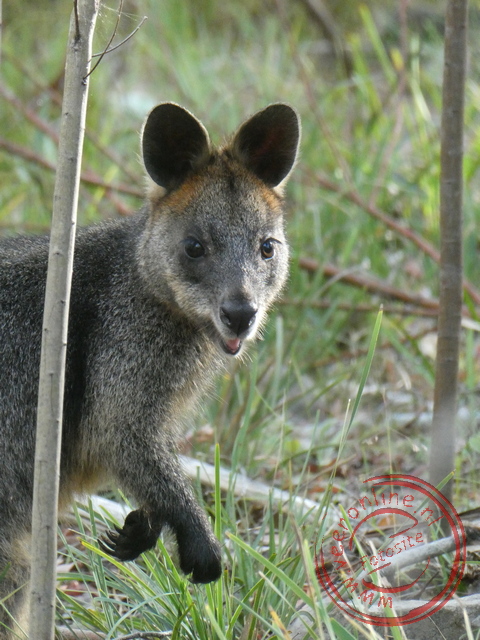 A curious kangaroo at Murrays Falls
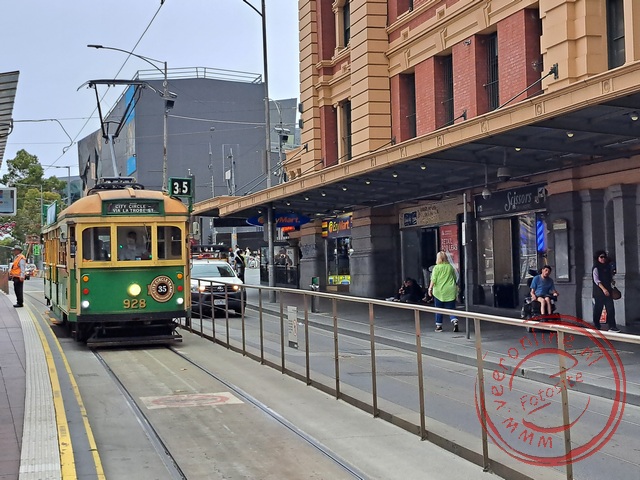 Tram 35 runs around the center of Melbourne
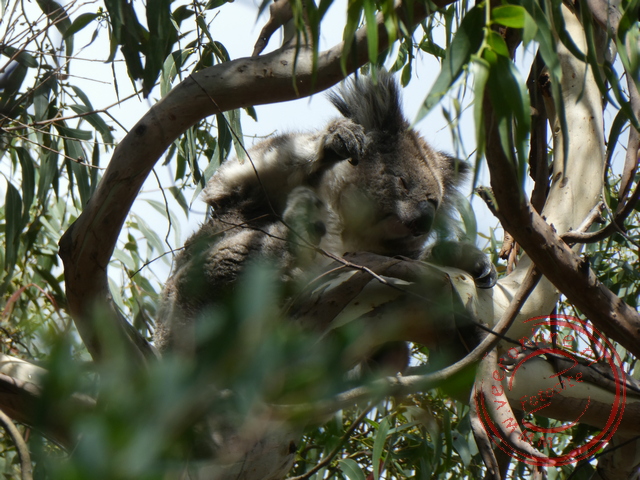 A koala bear in the trees near Kennett River
Travelogue Tour of Australia
Dag 2 | Australia > Arrival in Sydney
Dag 3 | Australia > The Sydney Opera House
Dag 4 | Australia > Walking to Bondi Beach
Dag 5 | Australia > In the Blue Mountains
Dag 6 | Australia > Wineglass Bay in Freycinet
Dag 7 | Australia > The Bay of Fires in Tasmania
Dag 8 | Australia > The Tasmanian Devils
Dag 9 | Australia > Melbourne in Christmas spirit
Dag 10 | Australia > Cycling through Melbourne
Dag 11 | Australia > The Great Ocean Road
Dag 12 | Australia > To the Pinnacle lookout
Dag 13 | Australia > The bus ride to Adelaide
Dag 14 | Australia > A short loop through Adelaide
Dag 15 | Australia > The Wilpena Pound in Flinders Ranges N.P.
Dag 16 | Australia > Sleeping underground in Coober Pedy
Dag 17 | Australia > Christmas at the famous Uluru Rock
Dag 18 | Australia > A walk around Uluru Rock
Dag 19 | Australia > Swimming in the West MacDonnell Ranges
Dag 20 | Australia > Nothing to do in Alice Springs
Dag 21 | Australia > Aboriginal rock art in Kakadu
Dag 22 | Australia > Boating on the Yellow River
Dag 23 | Australia > New Year's Eve in Darwin
Dag 24 | Australia > Early flight to Cairns
Dag 25 | Australia > Snorkeling at Fitzroy Island
Dag 26 | Australia > The Great Barrier Reef
Dag 27 | Australia > The Skyrail cable car to Kuranda
Dag 28 | Australia > Farewell to Cairns
Dag 29 | Australia > The flight from Singapore