
154 countries
(and areas)
 - Belize
- Benin
- Bhutan
- Bolivia
- Bonaire
- Bosnia and Herzegovina
- Botswana
- Brazil
- British Virgin Islands
- Brunei
- Bulgaria
- Cambodia
- Canada
- Cape Verde
- Chile
- China
- Costa Rica
- Croatia
- Cuba
- Curacao
- Cyprus
- Czech Republic
- Denmark
- Dominica
- Dominican Republic
- Egypt
- El Salvador
- England
- Estonia
- Eswatini (Swaziland)
- Ethiopia
- Fiji
- Finland
- France
- French Guiana
- Georgia
- Germany
- Gibraltar
- Greece
- Grenada
- Guadeloupe
- Guatemala
- Honduras
- Hong Kong
- Hungary
- Iceland
- India
- Indonesia
- Iran
- Ireland
- Israel
- Italy
- Jamaica
- Japan
- Jordan
- Kazakhstan
- Kenya
- Kosovo
- Kuwait
- Kyrgyzstan
- Laos
- Latvia
- Lebanon
- Lesotho
- Liechtenstein
- Lithuania
- Luxembourg
- Macau
- Madagascar
- Malawi
- Malaysia
- Maldives
- Malta
- Martinique
- Mexico
- Moldova
- Monaco
- Mongolia
- Montenegro
- Morocco
- Mozambique
- Namibia
- Nepal
- Netherlands
- New Zealand
- Nicaragua
- North Macedonia
- Northern Ireland
- Norway
- Oman
- Pakistan
- Palestine
- Peru
- Philippines
- Poland
- Portugal
- Qatar
- Republic of Korea
- Romania
- Russia
- Saint Kitts and Nevis
- Saint Lucia
- Saint Martin
- Saint Vincent and the Grenadines
- San Marino
- São Tomé and Principe
- Saudi Arabia
- Scotland
- Senegal
- Serbia
- Singapore
- Sint Maarten
- Slovakia
- Slovenia
- South Africa
- Spain
- Sri Lanka
- Suriname
- Sweden
- Switzerland
- Tajikistan
- Tanzania
- Thailand
- The Gambia
- Tibet
- Togo
- Transnistria
- Trinidad and Tobago
- Tunisia
- Turkey
- Turkmenistan
- Uganda
- United Arab Emirates
- United States
- Uruguay
- Uzbekistan
- Vatican City
- Vietnam
- Wales
- Zambia
- Zanzibar
- Belize
- Benin
- Bhutan
- Bolivia
- Bonaire
- Bosnia and Herzegovina
- Botswana
- Brazil
- British Virgin Islands
- Brunei
- Bulgaria
- Cambodia
- Canada
- Cape Verde
- Chile
- China
- Costa Rica
- Croatia
- Cuba
- Curacao
- Cyprus
- Czech Republic
- Denmark
- Dominica
- Dominican Republic
- Egypt
- El Salvador
- England
- Estonia
- Eswatini (Swaziland)
- Ethiopia
- Fiji
- Finland
- France
- French Guiana
- Georgia
- Germany
- Gibraltar
- Greece
- Grenada
- Guadeloupe
- Guatemala
- Honduras
- Hong Kong
- Hungary
- Iceland
- India
- Indonesia
- Iran
- Ireland
- Israel
- Italy
- Jamaica
- Japan
- Jordan
- Kazakhstan
- Kenya
- Kosovo
- Kuwait
- Kyrgyzstan
- Laos
- Latvia
- Lebanon
- Lesotho
- Liechtenstein
- Lithuania
- Luxembourg
- Macau
- Madagascar
- Malawi
- Malaysia
- Maldives
- Malta
- Martinique
- Mexico
- Moldova
- Monaco
- Mongolia
- Montenegro
- Morocco
- Mozambique
- Namibia
- Nepal
- Netherlands
- New Zealand
- Nicaragua
- North Macedonia
- Northern Ireland
- Norway
- Oman
- Pakistan
- Palestine
- Peru
- Philippines
- Poland
- Portugal
- Qatar
- Republic of Korea
- Romania
- Russia
- Saint Kitts and Nevis
- Saint Lucia
- Saint Martin
- Saint Vincent and the Grenadines
- San Marino
- São Tomé and Principe
- Saudi Arabia
- Scotland
- Senegal
- Serbia
- Singapore
- Sint Maarten
- Slovakia
- Slovenia
- South Africa
- Spain
- Sri Lanka
- Suriname
- Sweden
- Switzerland
- Tajikistan
- Tanzania
- Thailand
- The Gambia
- Tibet
- Togo
- Transnistria
- Trinidad and Tobago
- Tunisia
- Turkey
- Turkmenistan
- Uganda
- United Arab Emirates
- United States
- Uruguay
- Uzbekistan
- Vatican City
- Vietnam
- Wales
- Zambia
- Zanzibar


Copyright 2004 - 2026
Veeronline.nl Travel Adventures

Home > Tunisia > Tour of Tunisia > Travelogue day 2
Travelogue Tour of Tunisia
November 2229 2024 (8 days)
Tunisia > The old city of Carthage
Dag 2 - Saturday, November 23, 2024When I wake up, I take a shower. At the breakfast buffet, I meet most of the fellow travelers again. At half past eight, we gather at the bus. One room turns out not to have paid the tourist tax. It turns out to be our room, although we already paid. When I report this at the reception desk, the receptionist remembers that I did indeed pay. She apologizes. First, we drive to the old souq of Hammamet. I had expected this to be within walking distance of the hotel, but it is not. The hotel is located in the hotel district Hammamet-Yasmine. Old Hammamet is more than ten kilometers away. As we drive past the resorts, Mohamed explains that many hotels went bankrupt during the corona pandemic. I see many hotels standing empty and abandoned. The old medina of Hammamet lies by the harbor. I follow Mohamed through the historic entrance gate of the walled medina. The fort served as the city's defense. I walk through the narrow streets. Vendors are just opening their shops. It is still quiet in the medina. We stop briefly by some beautifully decorated doors. The colors symbolize Judaism (blue), Islam (green), Andalusia (yellow), and Turkish (red). Religious images are made on the doors with thumbtacks. The colors appear not only on the doors but also on the tiles applied to the houses. In the middle of the medina stands the mosque. Through covered streets, we enter the next district.

It is fun to wander through the narrow streets and discover the atmosphere of the medina. After the visit, we drive to the capital Tunis. It is quieter on the road this morning. Around eleven o'clock, we arrive at the Bardo Museum. A minibus stops in front of us. Anita gets out. She is the fellow traveler who could not take the flight yesterday. She flew to Tunis via Istanbul. What perfect timing. Now the group is complete. Together, we enter the museum. The Bardo Museum is one of the most important archaeological museums in the Arab world. It is housed in a former Ottoman palace and offers an extensive collection of ancient Roman mosaics. It is already half past twelve when we leave the museum. Although the original plan seemed to be to go to Carthage for lunch, it seems more practical to eat something first. Some fellow travelers still don’t have Tunisian money.

Therefore, we stop at an ATM. While they withdraw money, Mohamed updates the administration of the optional excursions during this trip. I had already chosen in advance to do the jeep safari. I also decide to join the excursion to the mountain oasis near Tozeur. I settle the payment for this excursion and the tip pool. Around two o'clock, we arrive at a restaurant. The buses parked in front reveal that this restaurant specializes in groups. The choice is limited to turkey or fish. I choose turkey. The lunch starts with a salad and ends with ice cream. I take a bit of everything. After all, it is lunch. After the meal, we drive to Carthage. Carthage was a powerful Phoenician city-state since the 9th century BC. During the Punic Wars, the city often fought with the Romans. In 146 BC, the Romans conquered and destroyed Carthage. The city was rebuilt and grew into an important city within the Roman Empire. Because of this, the remains of Carthage consist of two layers. The Punic ruins lie beneath the Roman buildings.

We walk toward the Mediterranean coast. Here lie the Baths of Antoninus. The baths were built in the 2nd century AD and were one of the largest bath complexes in the Roman Empire. We drive on to the Byrsa Hill. Byrsa Hill was the political and religious heart of ancient Carthage. Carthage was said to have been founded on this hill. Besides the Punic and Roman buildings, the Cathedral of Saint Louis is located here. From the hill, I see the city of Tunis. The sun is already low on the horizon. Before the sun sets, we quickly drive to the Sidi Bou Said district. This district is known for its white houses with blue doors and windows. The historic district, founded in the 13th century, is now mainly inhabited by artists, and the streets are filled with tourists. Every merchant claims to have the best prices with extra discounts. They invite me to look at the stalls. I politely decline. At the top of the district, there is a view over the Mediterranean Sea. When we walk back, the last rays of the sun cast an orange glow over the houses. A special sight. In the dark, we drive to today’s last activity. In the suburbs of Tunis is the Indinya Zero Waste Project.

Nick, one of the volunteers, explains that the awareness in Tunisia that waste can be reused is still lacking. In a workshop, it is explained how we can reuse glass bottles. A little later, I try to separate the bottom of a beer bottle to make a candle from it. A funny activity. At seven o'clock, we arrive in the dark at the El Mouradi hotel in the suburb of Tunis: Gammarth. It is a large five-star hotel. It takes some effort to find room 2130. First, we pass all the 2000 series rooms. A buffet is ready in the restaurant. It is busy. Numerous young people from different countries are here for a screen tournament. There is also a football team from Libya present. As a result, the huge restaurant is practically full. This also means that some dishes are no longer available. Fortunately, there are enough alternatives to choose from. In the lobby, we end the evening with a glass of wine. It was a long but very beautiful day.
 Tunisia
 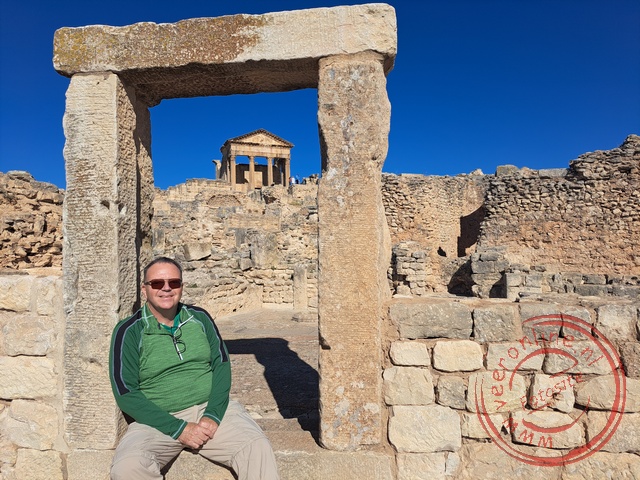 Over 2000 years of history in Dougga
 Hotel El Mouradi in Gammarth suburb of Tunis
 The nail images each have meaning
 The water was quite chilly in the hotel pool
Travelogue Tour of Tunisia
Dag 2 | Tunisia > The old city of Carthage
Dag 3 | Tunisia > The ruins of Dougga
Dag 4 | Tunisia > The mosque of Kairouan
Dag 5 | Tunisia > The mountain oasis near Tozeur
Dag 6 | Tunisia > Underground in Matmara
Dag 7 | Tunisia > Amphitheatre of El Djem
Dag 8 | Tunisia > Last time in Hammamet