
154 countries
(and areas)
 - Belize
- Benin
- Bhutan
- Bolivia
- Bonaire
- Bosnia and Herzegovina
- Botswana
- Brazil
- British Virgin Islands
- Brunei
- Bulgaria
- Cambodia
- Canada
- Cape Verde
- Chile
- China
- Costa Rica
- Croatia
- Cuba
- Curacao
- Cyprus
- Czech Republic
- Denmark
- Dominica
- Dominican Republic
- Egypt
- El Salvador
- England
- Estonia
- Eswatini (Swaziland)
- Ethiopia
- Fiji
- Finland
- France
- French Guiana
- Georgia
- Germany
- Gibraltar
- Greece
- Grenada
- Guadeloupe
- Guatemala
- Honduras
- Hong Kong
- Hungary
- Iceland
- India
- Indonesia
- Iran
- Ireland
- Israel
- Italy
- Jamaica
- Japan
- Jordan
- Kazakhstan
- Kenya
- Kosovo
- Kuwait
- Kyrgyzstan
- Laos
- Latvia
- Lebanon
- Lesotho
- Liechtenstein
- Lithuania
- Luxembourg
- Macau
- Madagascar
- Malawi
- Malaysia
- Maldives
- Malta
- Martinique
- Mexico
- Moldova
- Monaco
- Mongolia
- Montenegro
- Morocco
- Mozambique
- Namibia
- Nepal
- Netherlands
- New Zealand
- Nicaragua
- North Macedonia
- Northern Ireland
- Norway
- Oman
- Pakistan
- Palestine
- Peru
- Philippines
- Poland
- Portugal
- Qatar
- Republic of Korea
- Romania
- Russia
- Saint Kitts and Nevis
- Saint Lucia
- Saint Martin
- Saint Vincent and the Grenadines
- San Marino
- São Tomé and Principe
- Saudi Arabia
- Scotland
- Senegal
- Serbia
- Singapore
- Sint Maarten
- Slovakia
- Slovenia
- South Africa
- Spain
- Sri Lanka
- Suriname
- Sweden
- Switzerland
- Tajikistan
- Tanzania
- Thailand
- The Gambia
- Tibet
- Togo
- Transnistria
- Trinidad and Tobago
- Tunisia
- Turkey
- Turkmenistan
- Uganda
- United Arab Emirates
- United States
- Uruguay
- Uzbekistan
- Vatican City
- Vietnam
- Wales
- Zambia
- Zanzibar
- Belize
- Benin
- Bhutan
- Bolivia
- Bonaire
- Bosnia and Herzegovina
- Botswana
- Brazil
- British Virgin Islands
- Brunei
- Bulgaria
- Cambodia
- Canada
- Cape Verde
- Chile
- China
- Costa Rica
- Croatia
- Cuba
- Curacao
- Cyprus
- Czech Republic
- Denmark
- Dominica
- Dominican Republic
- Egypt
- El Salvador
- England
- Estonia
- Eswatini (Swaziland)
- Ethiopia
- Fiji
- Finland
- France
- French Guiana
- Georgia
- Germany
- Gibraltar
- Greece
- Grenada
- Guadeloupe
- Guatemala
- Honduras
- Hong Kong
- Hungary
- Iceland
- India
- Indonesia
- Iran
- Ireland
- Israel
- Italy
- Jamaica
- Japan
- Jordan
- Kazakhstan
- Kenya
- Kosovo
- Kuwait
- Kyrgyzstan
- Laos
- Latvia
- Lebanon
- Lesotho
- Liechtenstein
- Lithuania
- Luxembourg
- Macau
- Madagascar
- Malawi
- Malaysia
- Maldives
- Malta
- Martinique
- Mexico
- Moldova
- Monaco
- Mongolia
- Montenegro
- Morocco
- Mozambique
- Namibia
- Nepal
- Netherlands
- New Zealand
- Nicaragua
- North Macedonia
- Northern Ireland
- Norway
- Oman
- Pakistan
- Palestine
- Peru
- Philippines
- Poland
- Portugal
- Qatar
- Republic of Korea
- Romania
- Russia
- Saint Kitts and Nevis
- Saint Lucia
- Saint Martin
- Saint Vincent and the Grenadines
- San Marino
- São Tomé and Principe
- Saudi Arabia
- Scotland
- Senegal
- Serbia
- Singapore
- Sint Maarten
- Slovakia
- Slovenia
- South Africa
- Spain
- Sri Lanka
- Suriname
- Sweden
- Switzerland
- Tajikistan
- Tanzania
- Thailand
- The Gambia
- Tibet
- Togo
- Transnistria
- Trinidad and Tobago
- Tunisia
- Turkey
- Turkmenistan
- Uganda
- United Arab Emirates
- United States
- Uruguay
- Uzbekistan
- Vatican City
- Vietnam
- Wales
- Zambia
- Zanzibar


Copyright 2004 - 2026
Veeronline.nl Travel Adventures
Home > Kenya > Kenya and Tanzania > Travelogue day 4
Travelogue Kenya and Tanzania
January 14 February 4 2023 (22 days)
Kenya > Visiting the Samburu tribe
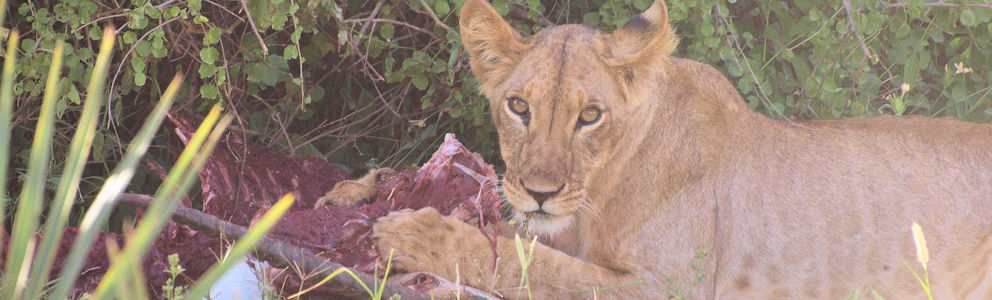
Dag 4 - Tuesday, 17 January 2023Early up. If you want to see animals, you have to start early! At quarter to six, my alarm goes off. I wash my face with some water. Then I have coffee and a sandwich. I’m not very hungry yet. With the truck, we enter the Samburu Reserve nature park again. In the morning, the park looks completely different. Impalas, antelopes, and gazelles graze on the open plain. I also see some elephants walking. One elephant is right in front of us on the dirt road. He has to move aside before we can pass. At the edge of the bushes near the river, we see a giraffe. The animal stays still at a safe distance, so I can admire it well. The spot where the lions were lying yesterday is now quiet. There isn’t even a bone or remains left of the gazelle they devoured. I wonder what they did with it. The lions turn out to be lying on the other side of the thicket. One lion walks around the thicket and disappears among the branches, into the shade. Along the river, several birds sit on the tree branches. Some birds of prey sit high up in the trees. In the lower branches sit the more colorful birds: the bee-eater and the lilac-breasted roller, Kenya’s national bird. Near a tree, two jeeps are stopped. Could something be there? It turns out there is a cheetah lying in the shade. What a beautiful sight. The predator looks around but seems fine with all the attention. It appears more focused on its surroundings. Cheetahs are Africa’s fastest animals. They can run up to 120 km/h to catch prey. Back on the main road, we see a group of giraffes.

Five necks stick out above the bushes. Behind the trees, there are even more giraffes. I keep seeing more. The whole group of no less than seventeen giraffes passes by our truck, as if it were planned. This morning again, we were lucky to see a lot of beautiful nature. Can anything top this tonight? At the campsite, Silvia has prepared a combination of lunch and breakfast: pancakes, fries, and salad. Maybe an odd combination, but it tastes great. The campsite lies next to the Samburu tribe’s village. Some tribe members lead us through the village. The Samburu tribe is a nomadic people, Benson explains, one of the tribe members. This village of 180 inhabitants is their home base. When they move to other mountains, they sleep outdoors around a campfire. The Samburu are related to the Maasai but have their own traditions. The Samburu village consists of simple houses. Strong branches form the basis for the walls. They are bent around at the top to form a roof. The side walls are covered with corrugated iron sheets and the roof with plastic and skins. A house lasts about four to five years, Benson explains. Then a new house is built. Meanwhile, more villagers have arrived in the colorful traditional clothing of the tribe. They sing a welcome song. Of course, we are invited to join the dance. Jumping is part of the dance.

The tribes in this region are known for their ability to jump very high. In the village, we get to look inside a house. I carefully duck low enough to get through the low doorway. The house is at most six meters deep. The children sleep in the back, the adults in front. Within the tribe, a man may have several wives. Each wife has her own house. When the staff stands in front of the house, the man is in that house. At the school, children sing a song. Here, children learn not only the Samburu language but also Swahili and English, which will help them later on. The tour ends at the village square. A long row of mats with homemade souvenirs is displayed. It looks like every woman in the village has laid out a mat. Dozens of women hope to sell something. I buy a necklace hoping to support the village, although the pushy selling doesn’t feel nice. At the end of the afternoon, we enter Samburu National Park for the third and final time. We have already spotted a lot of wildlife. Will we be spoiled even more? We start this game drive heading toward the river. At a waterhole stand some giraffes. They spread their front legs wide to be able to drink. Other giraffes keep watch. Patrick explains that a giraffe can only bend its head down briefly because otherwise, too much blood would rush to its head. With a strong swing, the giraffe comes back up. Further on stand several jeeps. Could something be there? We quickly drive there. Other jeeps rush over as well. Two young male lions lie in the bushes.

They glance up at the attention, then lie back down in the shade. Near the river, there is more greenery. Birds flutter away in the bushes and trees as we pass. A Somali ostrich runs away. It’s funny to see how the ostrich shakes its head while running. Among the greenery, a dik-dik antelope hesitates between staying still or running away. A dik-dik is one of the smallest antelopes in Africa. The little animals look nervous. While driving along the riverbank, we pass a group of elephants grazing right next to the road. It remains a beautiful sight to see the enormous animals. A young elephant, a few years old, plays among the herd. As the sun begins to set on the horizon, we arrive at the river. The water level is low. On the other side of the river, a group of seven giraffes feeds on a large bush. All necks reach the higher branches. A young giraffe bends over to drink from the river. A beautiful end to today’s trip. While driving back, we suddenly see a lion lying down. There are three lions lying in the shade. It’s the same group we spotted yesterday. Now they lie a few hundred meters further on. Just before the exit, a large group of zebras grazes. Until now, we had only seen individual zebras. The sun has already set when we arrive back at the eco-lodge. Sylvia is preparing dinner. There’s still some time before we eat. I quickly take a shower. The water in the large plastic tank has been warmed by the sun. In the primitive shower room, it’s nice to have a shower. At half past seven, the meal is ready: coconut rice, vegetables, and warthog meat. Delicious. I have never eaten warthog before.
 Tanzania
  A crocodile just entering the water
 A hippo in the water
 A serval is a mediumsized catlike predator
 A group photo on the edge of the Ngorongoro crater
Travelogue Kenya and Tanzania
Dag 2 | Kenya > Camping near Mount Kenya
Dag 3 | Kenya > The Samburu National Reserve
Dag 4 | Kenya > Visiting the Samburu tribe
Dag 5 | Kenya > To the Thompson Falls
Dag 6 | Kenya > Rhinos in Nakuru N.P.
Dag 7 | Kenya > To the Keiyo Valley
Dag 8 | Kenya > Hiking in the Kerio Valley
Dag 9 | Kenya > The Mago School Project
Dag 10 | Kenya > Across the Tanzanian border
Dag 11 | Tanzania > Musoma on Lake Victoria
Dag 12 | Tanzania > To the Serengeti
Dag 13 | Tanzania > Tents blown over
Dag 14 | Tanzania > The Ngorongoro Crater
Dag 15 | Tanzania > Cycling through Karatu Town
Dag 16 | Tanzania > We're not allowed to leave
Dag 17 | Tanzania > Slave Market of Stone Town
Dag 18 | Zanzibar > Snorkeling at Fumba
Dag 19 | Zanzibar > Walking along the beach
Dag 20 | Zanzibar > Extra day on Zanzibar
Dag 21 | Zanzibar > Farewell to Zanzibar
Dag 22 | Zanzibar > Cold weather in the Netherlands