
154 countries
(and areas)
 - Belize
- Benin
- Bhutan
- Bolivia
- Bonaire
- Bosnia and Herzegovina
- Botswana
- Brazil
- British Virgin Islands
- Brunei
- Bulgaria
- Cambodia
- Canada
- Cape Verde
- Chile
- China
- Costa Rica
- Croatia
- Cuba
- Curacao
- Cyprus
- Czech Republic
- Denmark
- Dominica
- Dominican Republic
- Egypt
- El Salvador
- England
- Estonia
- Eswatini (Swaziland)
- Ethiopia
- Fiji
- Finland
- France
- French Guiana
- Georgia
- Germany
- Gibraltar
- Greece
- Grenada
- Guadeloupe
- Guatemala
- Honduras
- Hong Kong
- Hungary
- Iceland
- India
- Indonesia
- Iran
- Ireland
- Israel
- Italy
- Jamaica
- Japan
- Jordan
- Kazakhstan
- Kenya
- Kosovo
- Kuwait
- Kyrgyzstan
- Laos
- Latvia
- Lebanon
- Lesotho
- Liechtenstein
- Lithuania
- Luxembourg
- Macau
- Madagascar
- Malawi
- Malaysia
- Maldives
- Malta
- Martinique
- Mexico
- Moldova
- Monaco
- Mongolia
- Montenegro
- Morocco
- Mozambique
- Namibia
- Nepal
- Netherlands
- New Zealand
- Nicaragua
- North Macedonia
- Northern Ireland
- Norway
- Oman
- Pakistan
- Palestine
- Peru
- Philippines
- Poland
- Portugal
- Qatar
- Republic of Korea
- Romania
- Russia
- Saint Kitts and Nevis
- Saint Lucia
- Saint Martin
- Saint Vincent and the Grenadines
- San Marino
- São Tomé and Principe
- Saudi Arabia
- Scotland
- Senegal
- Serbia
- Singapore
- Sint Maarten
- Slovakia
- Slovenia
- South Africa
- Spain
- Sri Lanka
- Suriname
- Sweden
- Switzerland
- Tajikistan
- Tanzania
- Thailand
- The Gambia
- Tibet
- Togo
- Transnistria
- Trinidad and Tobago
- Tunisia
- Turkey
- Turkmenistan
- Uganda
- United Arab Emirates
- United States
- Uruguay
- Uzbekistan
- Vatican City
- Vietnam
- Wales
- Zambia
- Zanzibar
- Belize
- Benin
- Bhutan
- Bolivia
- Bonaire
- Bosnia and Herzegovina
- Botswana
- Brazil
- British Virgin Islands
- Brunei
- Bulgaria
- Cambodia
- Canada
- Cape Verde
- Chile
- China
- Costa Rica
- Croatia
- Cuba
- Curacao
- Cyprus
- Czech Republic
- Denmark
- Dominica
- Dominican Republic
- Egypt
- El Salvador
- England
- Estonia
- Eswatini (Swaziland)
- Ethiopia
- Fiji
- Finland
- France
- French Guiana
- Georgia
- Germany
- Gibraltar
- Greece
- Grenada
- Guadeloupe
- Guatemala
- Honduras
- Hong Kong
- Hungary
- Iceland
- India
- Indonesia
- Iran
- Ireland
- Israel
- Italy
- Jamaica
- Japan
- Jordan
- Kazakhstan
- Kenya
- Kosovo
- Kuwait
- Kyrgyzstan
- Laos
- Latvia
- Lebanon
- Lesotho
- Liechtenstein
- Lithuania
- Luxembourg
- Macau
- Madagascar
- Malawi
- Malaysia
- Maldives
- Malta
- Martinique
- Mexico
- Moldova
- Monaco
- Mongolia
- Montenegro
- Morocco
- Mozambique
- Namibia
- Nepal
- Netherlands
- New Zealand
- Nicaragua
- North Macedonia
- Northern Ireland
- Norway
- Oman
- Pakistan
- Palestine
- Peru
- Philippines
- Poland
- Portugal
- Qatar
- Republic of Korea
- Romania
- Russia
- Saint Kitts and Nevis
- Saint Lucia
- Saint Martin
- Saint Vincent and the Grenadines
- San Marino
- São Tomé and Principe
- Saudi Arabia
- Scotland
- Senegal
- Serbia
- Singapore
- Sint Maarten
- Slovakia
- Slovenia
- South Africa
- Spain
- Sri Lanka
- Suriname
- Sweden
- Switzerland
- Tajikistan
- Tanzania
- Thailand
- The Gambia
- Tibet
- Togo
- Transnistria
- Trinidad and Tobago
- Tunisia
- Turkey
- Turkmenistan
- Uganda
- United Arab Emirates
- United States
- Uruguay
- Uzbekistan
- Vatican City
- Vietnam
- Wales
- Zambia
- Zanzibar


Copyright 2004 - 2026
Veeronline.nl Travel Adventures

Home > Romania > Tour of Romania > Travelogue day 4
Travelogue Tour of Romania
July 1120 2025 (10 days)
Romania > The Transfagarasan Mountain Pass
Dag 4 - Monday, July 14, 2025On the terrace at the guesthouse, we order breakfast from the menu. It is emphasized several times that breakfast is not included. We know that. Coffee is included in the menu, but cappuccino costs extra. That leaves only a bread roll, croissant, and jam on the menu. We leave at nine o’clock. It turns out there is a fourth car in the narrow strip beside the hotel and a motorcycle. Since the car in front of us has already driven off, we can just squeeze past the vehicles and drive away. On the south side of Curtea de Arges is the city’s monastery. Here stands a small Orthodox cathedral dating from 1512. The cathedral of the monastery is depicted on the one Lei banknote. Unfortunately, this church is also scaffolding-covered. This makes the two remarkable spiral-shaped towers hard to see. Inside, frescoes have been painted and the church is decorated with many golden ornaments. Several pillars are also spiral-shaped. We also briefly enter the neighboring monastery. Here we can see the chapel church. This church is beautiful as well. Curtea de Arges lies at the foot of the Fagaras Mountains. In the 1970s, the then dictator Ceausescu had an escape route built through the mountains.

Via this route, he could escape in the event of a possible Russian invasion. Today, the Transfagarasan highway is one of the most beautiful mountain roads in Europe and popular with tourists. After a few kilometers, we pass the sign marking the start of the mountain pass. Fortunately, it also states that the pass is open. In the winter months, the pass is closed. It only reopens on July 1. Our first stop is at Poenari Castle. The ruins can be reached by a staircase with no less than 1,480 steps. The stone staircase is surrounded by forest. Along the stairs runs an electric fence. This is to keep wild animals away. This is especially important for the brown bears in this area. Loud music also plays from speakers everywhere. I suspect this is also meant to keep bears at a distance. I steadily climb upward. After half an hour, I reach the castle ruins.

Due to its strategic location, the view over the surrounding mountains and valley is also magnificent. Poenari Castle was originally built by the Lords of Wallachia in the late 13th century. At that time, it was a modest defensive work, consisting of a single stone tower on a difficult-to-reach rocky peak. In the 15th century, the fort was expanded with several towers and walls three meters thick. Because of its location, the fort was nearly impregnable. In about twenty minutes, I descend again. A little further along the Transfagarasan highway lies the Vidraru reservoir. Since 1966, this lake has provided electricity to the region. Behind the 165-meter-high dam lies an enormous reservoir. When we see several cars stopped further along the lake, it turns out a bear is sitting by the roadside. The animal hopes to get something to eat. The bears’ habitat is shrinking due to human presence, causing them to appear more often in inhabited areas. This is not without danger, as was shown just over a week ago. A motorcyclist was dragged into a ravine by a bear on this road.

He did not survive. Along the hairpin bends through the forest, we encounter several bears, often with a few cars around them. Through the sharp curves, we climb higher and higher. Here the weather starts to turn cloudy again. About ten minutes from the top of the mountain pass, a heavy shower breaks loose. We reach the top via the kilometer-long Capra Tunnel. It is busy here. Everyone stops for a moment. We drive the car into a paid parking lot. One driver tries to slip into a small path to park further on, presumably for free. He hits an iron pipe with a loud bang. His exhaust breaks off. All to save two euros in parking fees. When it is briefly dry, we walk to a restaurant for lunch. There are also several options to buy something from one of the stalls. It is chilly at over two kilometers altitude. It is barely twelve degrees. From the restaurant, we have a view of Lake Balea. This small lake lies wedged between the surrounding mountains at an altitude of 2,042 meters. We accept that prices in this restaurant are a bit higher. After all, all the food must be brought here. When we step outside, it is raining again.

We skip a walk around the lake. The rain comes from the clouds pushed against the mountains. We start the descent over the most spectacular section of the Transfagarasan highway. From above, the sharp hairpin bends can be seen beautifully down into the valley. As soon as we start descending, the weather clears up. We drive the last bit of the pass toward Cartisoara with sunshine. From here, it is just over an hour to our overnight stay in Alba Iulia. Meanwhile, we receive instructions via WhatsApp on how to enter the apartment tonight. A video is even sent showing how to find the reserved parking spot and entrance of the apartment. Upon arrival, there is a car parked in our spot. A bystander helps call the owner. Everyone here seems to keep their phone number behind the windshield. The key to the apartment is in a key box. The building looks old. We take the small elevator to the second floor. Behind the door is a nicely furnished two-room apartment. However, there are two double beds. We thought we had booked with separate beds. Unfortunately. The apartment borders the old walled fortress of Alba Iulia. This makes up for the inconvenience. In the evening, we walk to the fortress and order something to eat on a terrace against the fortress wall. A beautiful location as darkness slowly falls outside.
 Romania
  The historic Saint Nicholas Church is being restored
 At Schiphol we are brought to the arrivals hall
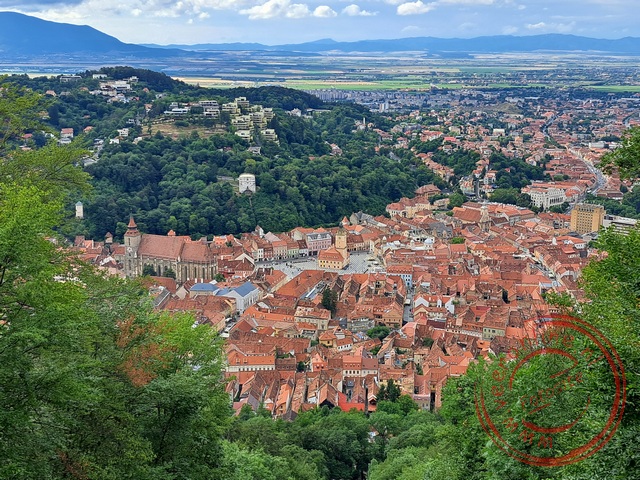 From the mountains there is a beautiful view over the city of Braov
 The Vilacrosse Passage in Bucharests old town
Travelogue Tour of Romania
Dag 2 | Romania > Wandering through the Lipscani District
Dag 3 | Romania > The Enormous Palace of Parliament
Dag 4 | Romania > The Transfagarasan Mountain Pass
Dag 5 | Romania > The Alba Carolina Citadel
Dag 6 | Romania > The Salt Mine of Turda
Dag 7 | Romania > Colorful Sighisoara
Dag 8 | Romania > Dracula's Castle
Dag 9 | Romania > Peles Castle
Dag 10 | Romania > Heading towards the Netherlands