
154 countries
(and areas)
 - Belize
- Benin
- Bhutan
- Bolivia
- Bonaire
- Bosnia and Herzegovina
- Botswana
- Brazil
- British Virgin Islands
- Brunei
- Bulgaria
- Cambodia
- Canada
- Cape Verde
- Chile
- China
- Costa Rica
- Croatia
- Cuba
- Curacao
- Cyprus
- Czech Republic
- Denmark
- Dominica
- Dominican Republic
- Egypt
- El Salvador
- England
- Estonia
- Eswatini (Swaziland)
- Ethiopia
- Fiji
- Finland
- France
- French Guiana
- Georgia
- Germany
- Gibraltar
- Greece
- Grenada
- Guadeloupe
- Guatemala
- Honduras
- Hong Kong
- Hungary
- Iceland
- India
- Indonesia
- Iran
- Ireland
- Israel
- Italy
- Jamaica
- Japan
- Jordan
- Kazakhstan
- Kenya
- Kosovo
- Kuwait
- Kyrgyzstan
- Laos
- Latvia
- Lebanon
- Lesotho
- Liechtenstein
- Lithuania
- Luxembourg
- Macau
- Madagascar
- Malawi
- Malaysia
- Maldives
- Malta
- Martinique
- Mexico
- Moldova
- Monaco
- Mongolia
- Montenegro
- Morocco
- Mozambique
- Namibia
- Nepal
- Netherlands
- New Zealand
- Nicaragua
- North Macedonia
- Northern Ireland
- Norway
- Oman
- Pakistan
- Palestine
- Peru
- Philippines
- Poland
- Portugal
- Qatar
- Republic of Korea
- Romania
- Russia
- Saint Kitts and Nevis
- Saint Lucia
- Saint Martin
- Saint Vincent and the Grenadines
- San Marino
- São Tomé and Principe
- Saudi Arabia
- Scotland
- Senegal
- Serbia
- Singapore
- Sint Maarten
- Slovakia
- Slovenia
- South Africa
- Spain
- Sri Lanka
- Suriname
- Sweden
- Switzerland
- Tajikistan
- Tanzania
- Thailand
- The Gambia
- Tibet
- Togo
- Transnistria
- Trinidad and Tobago
- Tunisia
- Turkey
- Turkmenistan
- Uganda
- United Arab Emirates
- United States
- Uruguay
- Uzbekistan
- Vatican City
- Vietnam
- Wales
- Zambia
- Zanzibar
- Belize
- Benin
- Bhutan
- Bolivia
- Bonaire
- Bosnia and Herzegovina
- Botswana
- Brazil
- British Virgin Islands
- Brunei
- Bulgaria
- Cambodia
- Canada
- Cape Verde
- Chile
- China
- Costa Rica
- Croatia
- Cuba
- Curacao
- Cyprus
- Czech Republic
- Denmark
- Dominica
- Dominican Republic
- Egypt
- El Salvador
- England
- Estonia
- Eswatini (Swaziland)
- Ethiopia
- Fiji
- Finland
- France
- French Guiana
- Georgia
- Germany
- Gibraltar
- Greece
- Grenada
- Guadeloupe
- Guatemala
- Honduras
- Hong Kong
- Hungary
- Iceland
- India
- Indonesia
- Iran
- Ireland
- Israel
- Italy
- Jamaica
- Japan
- Jordan
- Kazakhstan
- Kenya
- Kosovo
- Kuwait
- Kyrgyzstan
- Laos
- Latvia
- Lebanon
- Lesotho
- Liechtenstein
- Lithuania
- Luxembourg
- Macau
- Madagascar
- Malawi
- Malaysia
- Maldives
- Malta
- Martinique
- Mexico
- Moldova
- Monaco
- Mongolia
- Montenegro
- Morocco
- Mozambique
- Namibia
- Nepal
- Netherlands
- New Zealand
- Nicaragua
- North Macedonia
- Northern Ireland
- Norway
- Oman
- Pakistan
- Palestine
- Peru
- Philippines
- Poland
- Portugal
- Qatar
- Republic of Korea
- Romania
- Russia
- Saint Kitts and Nevis
- Saint Lucia
- Saint Martin
- Saint Vincent and the Grenadines
- San Marino
- São Tomé and Principe
- Saudi Arabia
- Scotland
- Senegal
- Serbia
- Singapore
- Sint Maarten
- Slovakia
- Slovenia
- South Africa
- Spain
- Sri Lanka
- Suriname
- Sweden
- Switzerland
- Tajikistan
- Tanzania
- Thailand
- The Gambia
- Tibet
- Togo
- Transnistria
- Trinidad and Tobago
- Tunisia
- Turkey
- Turkmenistan
- Uganda
- United Arab Emirates
- United States
- Uruguay
- Uzbekistan
- Vatican City
- Vietnam
- Wales
- Zambia
- Zanzibar


Copyright 2004 - 2026
Veeronline.nl Travel Adventures

Home > Portugal > Tram 28 Through Lisbon > Travelogue day 4
Travelogue Tram 28 Through Lisbon
April 30 May 4 2013 (5 days)
Portugal > The Palácio da Pena in Sintra
Dag 4 - Friday, May 3, 2013It’s just before 9:30 when I walk into Rossio Station. Today I’m taking the train to the town of Sintra, about thirty kilometers west of Lisbon. There’s a long line at the ticket counter, mostly tourists, I estimate. I decide to try the ticket machine instead. It turns out I don’t have a chip card. When I try the option to purchase one, it isn’t clear whether I’m buying a train ticket or a metro ticket. I give up and join the line at the counter after all. Because of this, I miss the next train to Sintra—but that’s no problem, as trains run every fifteen minutes. Shortly after, I’m on the train for a forty-minute ride to Sintra. When I arrive at Sintra station, I immediately notice that I’m not the only one wanting to visit the town and its palaces today. There’s a long line at the bus stop. One by one, everyone buys a ticket, and when the bus is full, it departs. Luckily, the next bus arrives soon. I take the bus to the Palácio da Pena, about five kilometers outside Sintra. The palace was built on the remains of a Hieronymite monastery. The 14th-century monastery had been heavily damaged by earthquakes and lightning strikes. In 1842, King Ferdinand decided to build the current palace for his wife, Maria II. Although all ticket counters are open, there are long lines here too. It takes over half an hour before I get a ticket. I enter the palace gardens, surprised at how much effort it took just to get here. I quickly walk up the steep path toward the palace. Although it’s busy with visitors, no lines form here.

I enter the palace and follow the visitor route, passing the Royal Dining Room and the Noble Room. It’s easy to see how people lived here in the early 20th century. From the window, I look out over the wide surroundings. Through the beautiful ballroom, I reach the kitchen, and then exit the palace via the broad yellow tower. Not only is the palace worth visiting, but the surrounding garden is also stunning. I follow the hiking path uphill and immediately leave the crowds behind. Nearly all tourists come just for the palace. With a steady climb, I reach the Monks’ Cave, a quiet place where monks once meditated. From here, I have a magnificent view of the palace, highlighted beautifully by the sun. Descending on the other side of the palace, I return to the palace garden. Through the exit for car visitors, I reach the main road. I walk to the nearest bus stop, which proves to be a good choice. I board one stop earlier. When the bus reaches the main entrance, I see long lines of waiting people. Today is just very busy. I get off in the center of Sintra. Sintra is a small town with narrow old streets and is also on UNESCO’s World Heritage list. The town center is dominated by the Palácio Nacional de Sintra, a somewhat strangely shaped building. Two enormous pointed chimneys rise above the palace.

Although it’s already afternoon, I still have plenty of time to visit the palace, as most other tourists have already been. The woman at the ticket counter sighs about the enormous crowds today. She doesn’t really know why it’s suddenly so busy but says it will remain that way for the rest of the summer. I enter the palace, the only surviving royal palace from the Middle Ages. I visit the ballroom and the king’s chamber, decorated with azulejo tiles. The ceiling paintings are particularly beautiful. Of course, I also peek into the kitchen, looking up from below at the two enormous chimneys. I leave the palace through the spacious central hall. I cross the square and wander through the narrow streets of Sintra. Most shops cater entirely to tourists. While there is a lively atmosphere, it is not very authentic—everyone sells the same things. I choose streets that lead me back to the station. I take the train back to Lisbon. Back in the capital, I look for a nice restaurant and find a cozy terrace on the steps leading to the Bairro Alto district. While enjoying sardines with local green wine, it gradually grows dark. A street musician plays his guitar to earn a few extra coins. My idyllic scene is rudely interrupted when someone snatches the musician’s tip jar and runs off. Sadly, the older musician takes it in stride—he played for nothing. As I leave, I give him an extra tip.
 Portugal
 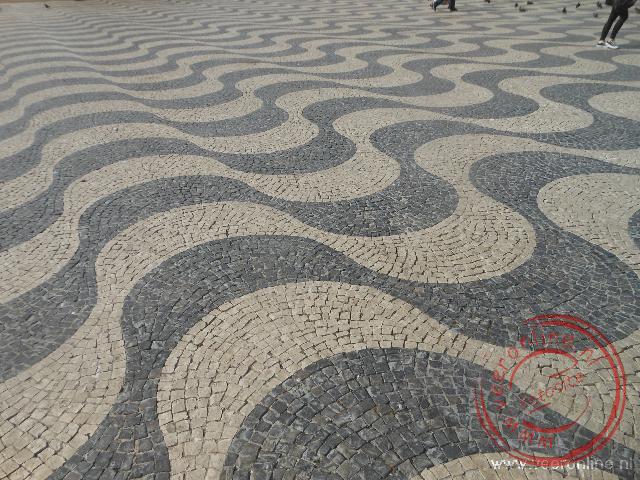 Because of its waveshaped paving Rossio Square is popularly known as the Square of the Wave Pattern
 The busy square with lots of traffic and lively terraces
 The 19thcentury Rossio train station
 Bronze statues hold the water jet firmly in place
Travelogue Tram 28 Through Lisbon
Dag 2 | Portugal > Tram line 28 is a household name
Dag 3 | Portugal > On foot to Belém
Dag 4 | Portugal > The Palácio da Pena in Sintra
Dag 5 | Portugal > Back home