
154 countries
(and areas)
 - Belize
- Benin
- Bhutan
- Bolivia
- Bonaire
- Bosnia and Herzegovina
- Botswana
- Brazil
- British Virgin Islands
- Brunei
- Bulgaria
- Cambodia
- Canada
- Cape Verde
- Chile
- China
- Costa Rica
- Croatia
- Cuba
- Curacao
- Cyprus
- Czech Republic
- Denmark
- Dominica
- Dominican Republic
- Egypt
- El Salvador
- England
- Estonia
- Eswatini (Swaziland)
- Ethiopia
- Fiji
- Finland
- France
- French Guiana
- Georgia
- Germany
- Gibraltar
- Greece
- Grenada
- Guadeloupe
- Guatemala
- Honduras
- Hong Kong
- Hungary
- Iceland
- India
- Indonesia
- Iran
- Ireland
- Israel
- Italy
- Jamaica
- Japan
- Jordan
- Kazakhstan
- Kenya
- Kosovo
- Kuwait
- Kyrgyzstan
- Laos
- Latvia
- Lebanon
- Lesotho
- Liechtenstein
- Lithuania
- Luxembourg
- Macau
- Madagascar
- Malawi
- Malaysia
- Maldives
- Malta
- Martinique
- Mexico
- Moldova
- Monaco
- Mongolia
- Montenegro
- Morocco
- Mozambique
- Namibia
- Nepal
- Netherlands
- New Zealand
- Nicaragua
- North Macedonia
- Northern Ireland
- Norway
- Oman
- Pakistan
- Palestine
- Peru
- Philippines
- Poland
- Portugal
- Qatar
- Republic of Korea
- Romania
- Russia
- Saint Kitts and Nevis
- Saint Lucia
- Saint Martin
- Saint Vincent and the Grenadines
- San Marino
- São Tomé and Principe
- Saudi Arabia
- Scotland
- Senegal
- Serbia
- Singapore
- Sint Maarten
- Slovakia
- Slovenia
- South Africa
- Spain
- Sri Lanka
- Suriname
- Sweden
- Switzerland
- Tajikistan
- Tanzania
- Thailand
- The Gambia
- Tibet
- Togo
- Transnistria
- Trinidad and Tobago
- Tunisia
- Turkey
- Turkmenistan
- Uganda
- United Arab Emirates
- United States
- Uruguay
- Uzbekistan
- Vatican City
- Vietnam
- Wales
- Zambia
- Zanzibar
- Belize
- Benin
- Bhutan
- Bolivia
- Bonaire
- Bosnia and Herzegovina
- Botswana
- Brazil
- British Virgin Islands
- Brunei
- Bulgaria
- Cambodia
- Canada
- Cape Verde
- Chile
- China
- Costa Rica
- Croatia
- Cuba
- Curacao
- Cyprus
- Czech Republic
- Denmark
- Dominica
- Dominican Republic
- Egypt
- El Salvador
- England
- Estonia
- Eswatini (Swaziland)
- Ethiopia
- Fiji
- Finland
- France
- French Guiana
- Georgia
- Germany
- Gibraltar
- Greece
- Grenada
- Guadeloupe
- Guatemala
- Honduras
- Hong Kong
- Hungary
- Iceland
- India
- Indonesia
- Iran
- Ireland
- Israel
- Italy
- Jamaica
- Japan
- Jordan
- Kazakhstan
- Kenya
- Kosovo
- Kuwait
- Kyrgyzstan
- Laos
- Latvia
- Lebanon
- Lesotho
- Liechtenstein
- Lithuania
- Luxembourg
- Macau
- Madagascar
- Malawi
- Malaysia
- Maldives
- Malta
- Martinique
- Mexico
- Moldova
- Monaco
- Mongolia
- Montenegro
- Morocco
- Mozambique
- Namibia
- Nepal
- Netherlands
- New Zealand
- Nicaragua
- North Macedonia
- Northern Ireland
- Norway
- Oman
- Pakistan
- Palestine
- Peru
- Philippines
- Poland
- Portugal
- Qatar
- Republic of Korea
- Romania
- Russia
- Saint Kitts and Nevis
- Saint Lucia
- Saint Martin
- Saint Vincent and the Grenadines
- San Marino
- São Tomé and Principe
- Saudi Arabia
- Scotland
- Senegal
- Serbia
- Singapore
- Sint Maarten
- Slovakia
- Slovenia
- South Africa
- Spain
- Sri Lanka
- Suriname
- Sweden
- Switzerland
- Tajikistan
- Tanzania
- Thailand
- The Gambia
- Tibet
- Togo
- Transnistria
- Trinidad and Tobago
- Tunisia
- Turkey
- Turkmenistan
- Uganda
- United Arab Emirates
- United States
- Uruguay
- Uzbekistan
- Vatican City
- Vietnam
- Wales
- Zambia
- Zanzibar


Copyright 2004 - 2026
Veeronline.nl Travel Adventures

Home > Singapore > From Singapore to Hong Kong > Travelogue day 4
Travelogue From Singapore to Hong Kong
Januari 5-19, 2026 (15 days)
Singapore > Chinatown and Little India
Dag 4 - Thursday, January 8, 2026I wake up to the alarm clock. I have slept for eleven hours. I take a shower and get dressed. A breakfast buffet is ready on the ground floor. I notice that there are also Russians staying here. Could they be joining the cruise as well? China and probably Singapore are pro-Russian in the occupation of Ukrainian territory. After breakfast we walk to Chinatown. We take a wrong turn and end up in Pearl’s Hill City Park. In fact, this route also leads to Pagoda Street, but first it goes up a series of stairs and then back down again. On the other side of the park, a passer-by points out how we can get to Chinatown. I am surprised by the height differences in the city here. Via a staircase we descend to the beginning of Pagoda Street, the main street of Chinatown. During the 19th century, the area south of the Singapore River mainly consisted of warehouses. The mostly Chinese laborers lived in primitive houses in between. Nowadays, Chinatown is a lively district full of restaurants and small shops. Even though it is still morning, people are already eating everywhere. At the end of Pagoda Street stands the Sri Mariamman Temple. The Sri Mariamman Temple is the oldest and most important Hindu temple in Singapore and is located in the heart of Chinatown. The temple was founded in 1827 by Indian immigrants. Immediately striking is the gopuram (entrance tower), covered with colorful statues of Hindu gods and mythical figures. Music can be heard coming from the temple. There seems to be a ceremony taking place. A special sight. We walk through the streets towards the Thian Hock Keng Temple. At first glance, this temple appears to be closed due to construction work. When we walk around the complex, we are able to enter the temple from the other side. Here too, it is a mix of Chinese Taoism and Buddhism. We continue on to the Buddha Tooth Relic Temple in Chinatown. Supposedly, a tooth of Buddha is kept here as a relic. First, we enter the large main hall with Buddha. Along the sides stand thousands of small Buddha statues. An attendant tells us that the historical tooth is located on the fourth floor.

We take the elevator up. In the hall we see a display case with gilded Buddha statues. The tooth is said to be inside the casket. Has anyone ever seen this tooth? In the basement of the temple complex there is a restaurant. We order something to drink. Here we are really sitting among the local people. We have seen enough of Chinatown and take the metro to Little India—or so we think. Our bank cards do not work at the metro gates. When we want to buy a ticket at the machine, we first need a chip card. We can buy one at the counter, but only with cash. Sigh. We do not yet have Singapore dollars. We are referred to an ATM. We can also only buy a card with ten dollars of credit. By now, a taxi would be cheaper. Because we plan to use the metro more often, we decide to withdraw money, buy the card, and take the metro after all. Three stops later we get off in the Little India district. We have to get our bearings for a moment once we are back above ground. We walk to Serangoon Road. In this busy street there are still many small traditional businesses, mainly run by Indians. Just like in Chinatown, people are eating everywhere, but the dishes here are more Indian. We arrive at the Sri Veeramakaliamman Temple. A colorful entrance gate with Hindu images stands above the entrance. Unfortunately, the temple is closed at midday. It does not reopen until half past four. We do not wait for that. We walk through the narrow streets. At a restaurant on a street corner we order cola—a good opportunity to observe street life in this Indian neighborhood. Finally, we walk on to the Arab quarter. By the river, exactly between the two districts, stands the Church of Our Lady of Lourdes.

The entirely white church appears to be closed. Yet the gate is open. The doorman gestures that we may enter the grounds. The church looks simple. A few hundred meters further on is the large Sultan Mosque. The Sultan Mosque (Masjid Sultan) is one of the most important and impressive religious buildings in Singapore. The mosque is located in the historic Kampong Glam district, the center of the Malay-Islamic community. It was originally built in 1824 for Sultan Hussein Shah, the first sultan of Singapore, and replaced in the 1920s by the current, larger building. The mosque is immediately recognizable by its enormous golden dome and two slender minarets. At the entrance we take off our shoes. When we want to step inside, it turns out we are standing at the entrance for Muslims. We are told to walk around the mosque. We put our shoes back on and walk around. From the rear of the mosque we can admire the relatively simple interior. We have already seen a lot today. We decide to skip Haji Lane and only visit the Malay Heritage Centre. We have some trouble finding the entrance. When we stand in front of the building, a man gestures with crossed wrists that it is closed due to renovation. Actually, neither of us minds this very much. We head back to the hotel. On the way to the metro station, a taxi passes by. We flag it down and have it drop us off at the Holiday Inn Express hotel. For the price, we don’t have to think twice—it costs just eight Singapore dollars (five euros). At the beginning of the evening we walk again towards the Singapore River. In the Clarke Quay area, the lights are switched on. On a terrace by the river we order a Singapore Sling, a local cocktail with gin, brandy, and Cointreau.
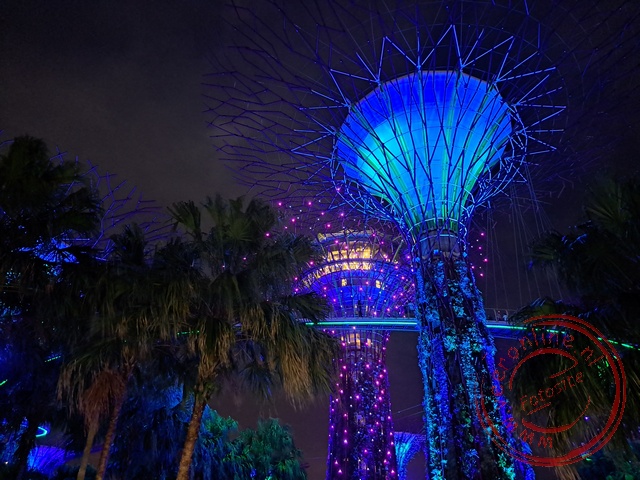
We also order some small spring rolls. After that we order dinner. During the meal we strike up a conversation with a young couple from Singapore at the table next to us. They work in the financial district and have gone out to eat before heading home. They both work at Malayan Bank. Around half past seven we pay the bill. We walk to Marina Bay. There is a light and fountain show at eight o’clock. We arrive just in time. The show is a bit disappointing. I had heard so much about it. Probably part of the show is lost due to the strong wind; the projections on the created mist disappear. The show lasts fifteen minutes. After the show we walk through the luxurious Marina Bay Sands hotel. On the other side, via a pedestrian bridge, we reach Gardens by the Bay. The route is impossible to miss—we simply follow the flow of people. When we arrive beneath the artificial trees of Gardens by the Bay, another light and sound show begins. The Supertrees are illuminated in time with the music. Many spectators are lying on the ground to enjoy the spectacle. How beautiful and special this is. After the show ends, we go in search of the metro station. We are not alone—there are bottlenecks on the stairs and at the elevators. We wait patiently. By metro we travel four stops back to our hotel. It has been a wonderful and special day. Tomorrow morning we will pack our luggage again, and later in the day we will head to the cruise terminal for our adventure at sea. We are very much looking forward to it.
 Hong Kong
 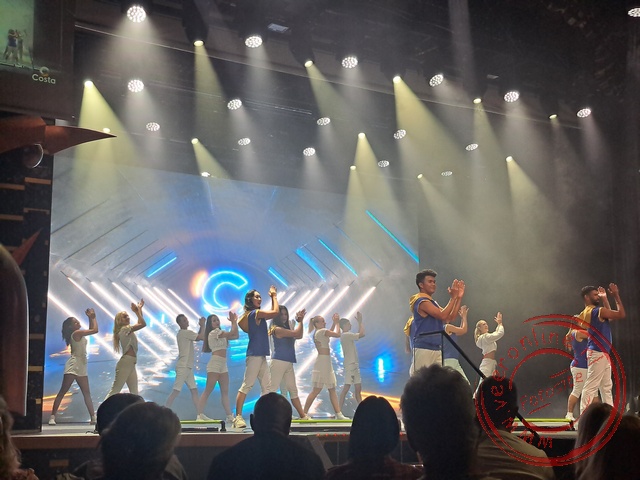 The closing performance
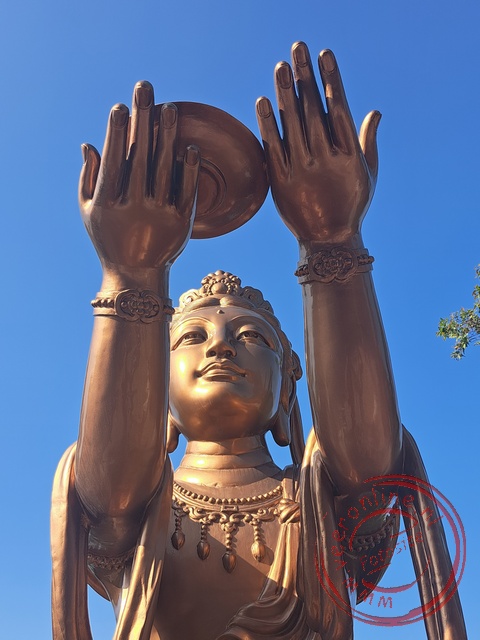 Golden statues in the Po Lin Monastery
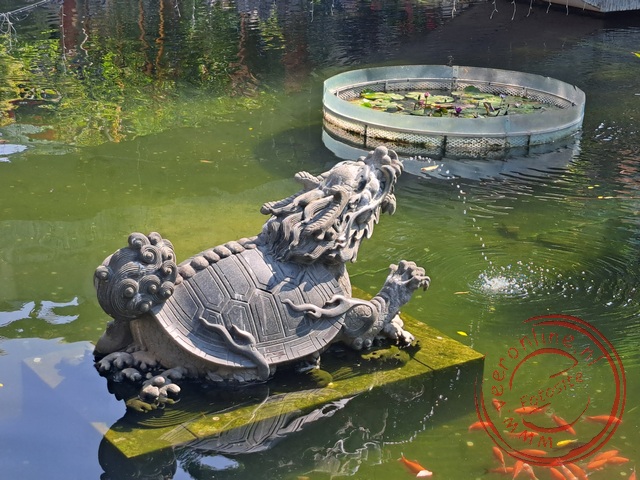 A dragon in Wong Tai Sin
 Philippines
 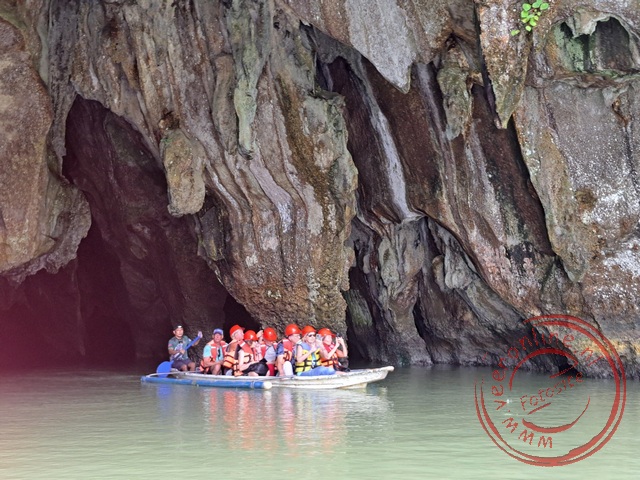 The underground river is seven kilometers long
Travelogue From Singapore to Hong Kong
Dag 2 | Singapore > A Day at the Airport
Dag 3 | Singapore > Still in Singapore
Dag 4 | Singapore > Chinatown and Little India
Dag 5 | Singapore > The Cloud Forest of Singapore
Dag 6 | Brunei > A day at sea
Dag 7 | Brunei > The small state of Brunei
Dag 8 | Philippines > Enjoying life on board
Dag 9 | Philippines > The underground river of Palawan
Dag 10 | Hong Kong > Two days on the South China Sea - 1
Dag 11 | Hong Kong > Two days on the South China Sea - 2
Dag 12 | Hong Kong > Victoria Peak of Hong Kong
Dag 13 | Macau > Visit to Macau
Dag 14 | Hong Kong > By cable car to the Buddha
Dag 15 | Hong Kong > Snow in Istanbul