
154 countries
(and areas)
 - Belize
- Benin
- Bhutan
- Bolivia
- Bonaire
- Bosnia and Herzegovina
- Botswana
- Brazil
- British Virgin Islands
- Brunei
- Bulgaria
- Cambodia
- Canada
- Cape Verde
- Chile
- China
- Costa Rica
- Croatia
- Cuba
- Curacao
- Cyprus
- Czech Republic
- Denmark
- Dominica
- Dominican Republic
- Egypt
- El Salvador
- England
- Estonia
- Eswatini (Swaziland)
- Ethiopia
- Fiji
- Finland
- France
- French Guiana
- Georgia
- Germany
- Gibraltar
- Greece
- Grenada
- Guadeloupe
- Guatemala
- Honduras
- Hong Kong
- Hungary
- Iceland
- India
- Indonesia
- Iran
- Ireland
- Israel
- Italy
- Jamaica
- Japan
- Jordan
- Kazakhstan
- Kenya
- Kosovo
- Kuwait
- Kyrgyzstan
- Laos
- Latvia
- Lebanon
- Lesotho
- Liechtenstein
- Lithuania
- Luxembourg
- Macau
- Madagascar
- Malawi
- Malaysia
- Maldives
- Malta
- Martinique
- Mexico
- Moldova
- Monaco
- Mongolia
- Montenegro
- Morocco
- Mozambique
- Namibia
- Nepal
- Netherlands
- New Zealand
- Nicaragua
- North Macedonia
- Northern Ireland
- Norway
- Oman
- Pakistan
- Palestine
- Peru
- Philippines
- Poland
- Portugal
- Qatar
- Republic of Korea
- Romania
- Russia
- Saint Kitts and Nevis
- Saint Lucia
- Saint Martin
- Saint Vincent and the Grenadines
- San Marino
- São Tomé and Principe
- Saudi Arabia
- Scotland
- Senegal
- Serbia
- Singapore
- Sint Maarten
- Slovakia
- Slovenia
- South Africa
- Spain
- Sri Lanka
- Suriname
- Sweden
- Switzerland
- Tajikistan
- Tanzania
- Thailand
- The Gambia
- Tibet
- Togo
- Transnistria
- Trinidad and Tobago
- Tunisia
- Turkey
- Turkmenistan
- Uganda
- United Arab Emirates
- United States
- Uruguay
- Uzbekistan
- Vatican City
- Vietnam
- Wales
- Zambia
- Zanzibar
- Belize
- Benin
- Bhutan
- Bolivia
- Bonaire
- Bosnia and Herzegovina
- Botswana
- Brazil
- British Virgin Islands
- Brunei
- Bulgaria
- Cambodia
- Canada
- Cape Verde
- Chile
- China
- Costa Rica
- Croatia
- Cuba
- Curacao
- Cyprus
- Czech Republic
- Denmark
- Dominica
- Dominican Republic
- Egypt
- El Salvador
- England
- Estonia
- Eswatini (Swaziland)
- Ethiopia
- Fiji
- Finland
- France
- French Guiana
- Georgia
- Germany
- Gibraltar
- Greece
- Grenada
- Guadeloupe
- Guatemala
- Honduras
- Hong Kong
- Hungary
- Iceland
- India
- Indonesia
- Iran
- Ireland
- Israel
- Italy
- Jamaica
- Japan
- Jordan
- Kazakhstan
- Kenya
- Kosovo
- Kuwait
- Kyrgyzstan
- Laos
- Latvia
- Lebanon
- Lesotho
- Liechtenstein
- Lithuania
- Luxembourg
- Macau
- Madagascar
- Malawi
- Malaysia
- Maldives
- Malta
- Martinique
- Mexico
- Moldova
- Monaco
- Mongolia
- Montenegro
- Morocco
- Mozambique
- Namibia
- Nepal
- Netherlands
- New Zealand
- Nicaragua
- North Macedonia
- Northern Ireland
- Norway
- Oman
- Pakistan
- Palestine
- Peru
- Philippines
- Poland
- Portugal
- Qatar
- Republic of Korea
- Romania
- Russia
- Saint Kitts and Nevis
- Saint Lucia
- Saint Martin
- Saint Vincent and the Grenadines
- San Marino
- São Tomé and Principe
- Saudi Arabia
- Scotland
- Senegal
- Serbia
- Singapore
- Sint Maarten
- Slovakia
- Slovenia
- South Africa
- Spain
- Sri Lanka
- Suriname
- Sweden
- Switzerland
- Tajikistan
- Tanzania
- Thailand
- The Gambia
- Tibet
- Togo
- Transnistria
- Trinidad and Tobago
- Tunisia
- Turkey
- Turkmenistan
- Uganda
- United Arab Emirates
- United States
- Uruguay
- Uzbekistan
- Vatican City
- Vietnam
- Wales
- Zambia
- Zanzibar


Copyright 2004 - 2026
Veeronline.nl Travel Adventures
Home > Germany > City Trip Berlin > Travelogue day 4
Travelogue City Trip Berlin
July 31 August 5 2020 (6 days)
Germany > Unter den Linden Boulevard
Dag 4 - Monday 3 August 2020Today we are set to explore the area between Unter den Linden boulevard and Alexanderplatz. The center of the former East German part of Berlin. From Friedrichstrasse, we walk toward the famous boulevard. To our right, in the direction of the Brandenburg Gate, lie the French and Russian embassies. Also located here is the luxury Hotel Adlon. Unter den Linden was once the grand avenue of Prussian kings and German emperors. In the 17th century, the street was planted with linden trees, from which it takes its name. The two-kilometer-long avenue between the Brandenburg Gate and Alexanderplatz features many historic buildings. Today, Unter den Linden is one of the main streets with luxury shops. The green strip in the middle is marred by construction work for a new metro line. Just behind the boulevard lies the Gendarmenmarkt, considered by many to be the most beautiful square in Berlin. On either side of the square stand two identical churches: the French and the German cathedrals. Exactly between them lies the Concert Hall. We continue on to Bebelplatz. This square borders the State Opera, the Catholic cathedral with a large round dome, and the former library. Like the Gendarmenmarkt, this square is magnificent. Back at Unter den Linden boulevard, we pass the university and the war memorial. The monument features a simple statue of a mother mourning her son. The cold emptiness in the space makes the monument very moving.

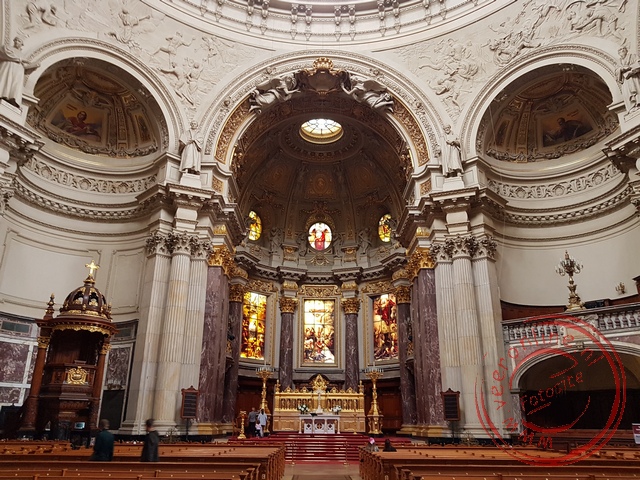
We cross the Schlossbrücke and arrive at Museum Island (Museumsinsel). To our right, the Schloss is being rebuilt. Unlike many other buildings, this castle was only slightly damaged during the war, but the later East German city government decided to demolish it. In recent years, funds have been raised to reconstruct the Schloss in its original state. To the left stands the Altes Museum. This museum was the first on the island, built in 1823 by order of King Friedrich Wilhelm III of Prussia. It soon became clear the museum was too small, and several more museums were built. Today, five museums stand on the island in the Spree River. Straight ahead stands the impressive Berlin Cathedral (Berliner Dom). The 98-meter-high dome towers above the museums. We join the queue for the entrance. It is just a few minutes before the church opens at eleven o’clock. We could only buy reduced tickets online, probably due to corona. Perhaps not everything inside is accessible. We enter without problems. I am impressed when I step into the Berliner Dom. How overwhelmingly beautiful it is. The current church construction began in 1894 but was heavily damaged in World War II. The reconstruction opted for a simpler design. The dome is also slightly lower than originally. The Renaissance and Baroque interior is beautifully restored. The main organ, the Sauer organ, is world-famous. I take a seat to soak in the splendor and better admire the enormous dome. In a corner of the church, a staircase leads upward. A sign warns that it is 267 steps up with no option to turn back. We decide to go. Slowly we climb. The higher we go, the narrower the staircase becomes. At two-thirds height, we stand beneath the dome. From a small balcony, we look into the cathedral. A narrow circular corridor leads all around the dome. From here, the stairs to the panorama deck begin. We climb the last 101 steps on a steel spiral staircase. At the top, we are rewarded with a magnificent view over Museum Island, the boulevard, and the Tiergarten.
All around we see Berlin. We also see the tall Fernsehturm, which will be our destination later today. The Nicolas Quarter is where Berlin first originated. The neighborhood once had narrow streets and small houses around St. Nicholas Church from 1220. In the 1930s, the Nazis planned to demolish the quarter. The messy streets did not fit their vision for the capital of the German Reich. This was prevented. However, during the war, heavy bombing destroyed the quarter entirely. It was demolished anyway. In the 1980s, the quarter around the church was restored. At one of the terraces, we order coffee. The church itself can only be visited on weekends and is no longer used for religious purposes. Just next to this neighborhood lies the Rotes Rathaus. The red-brick building from 1861 is the city hall. During the GDR period, it served only East Berlin; after reunification, it became the city hall for all of Berlin. Due to the city's growth, a new city hall has also been built. On the square in front of the Rathaus, just before Mariankirche, a demonstration is underway — this time in support of the Yazidis in Syria. We head to the Fernsehturm. This 368-meter-high tower is the city’s landmark. There is a long line at the entrance. Because we reserved tickets in advance, we can enter through the fast-pass. In seconds, the elevator takes us to the observation platform at 203 meters. What an amazing view. I see the buildings we visited this morning. I see the railway tracks near our hotel and the Tiergarten as a green oasis in the city. In every direction, information boards indicate which buildings are visible, providing a nice explanation of the city. After forty minutes, we are back down. We pass through Alexanderplatz train station to reach the famous square. The square was named in 1805 after Tsar Alexander I of Russia, who visited the city. The square’s reputation exceeds its appearance. Large concrete buildings with endless flats behind them seem to transport us back to the GDR era. The neon signs do little to change that impression. To the right of the square lies the Alexa department store. The purple-pink building is beautifully ugly. Inside are only luxury shops. We follow the railway back toward the hotel. The S-Bahn was elevated in 1930. Hundreds of arches were made under the tracks. Today, shops and cafes occupy these arches. At Hackescher Markt square, where we ate last night, we order a beer. The Jewish Quarter, adjacent to this square, has several courtyards. We wander the streets and occasionally step into a courtyard. The Hackeschen Höfe consist of many interconnected courtyards. We walk from courtyard to courtyard. Many have cafes and terraces. From here, we walk back to the hotel. It’s five o’clock when we arrive. At a terrace, we order something to eat. In the evening, we walk to the Reichstag.

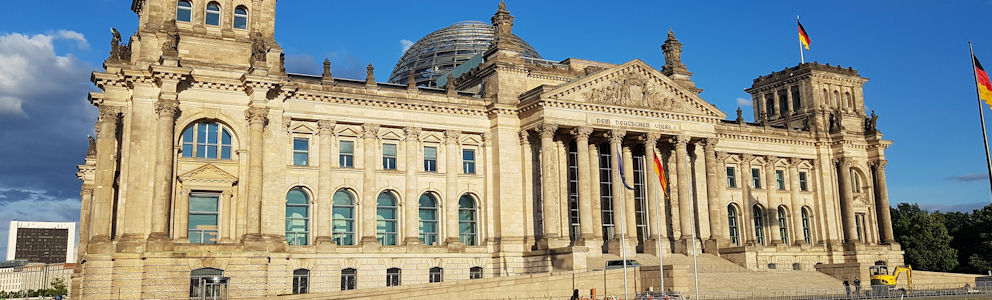
We have tickets to visit the glass dome of the Reichstag at eight o’clock. First, there is a strict security check, just like at an airport. We are allowed through. A staff member guides us to the elevator. Upstairs we enter the glass dome. The original dome was lost in the fire of 1933. Only in 1995 was the Reichstag given a dome again. Light in the dome is reflected downwards by mirrors, illuminating the parliamentary chamber below. Through photos, the history of Germany is displayed. A spiral walkway leads to the top of the dome, from which we have a fantastic view over the city. The low sun lights up the center. The top of the dome is open. During rain showers, water falls into the dome. The water is collected and reused, a guard explains.
 Germany
  Numerous statues stand in the palace garden in Potsdam
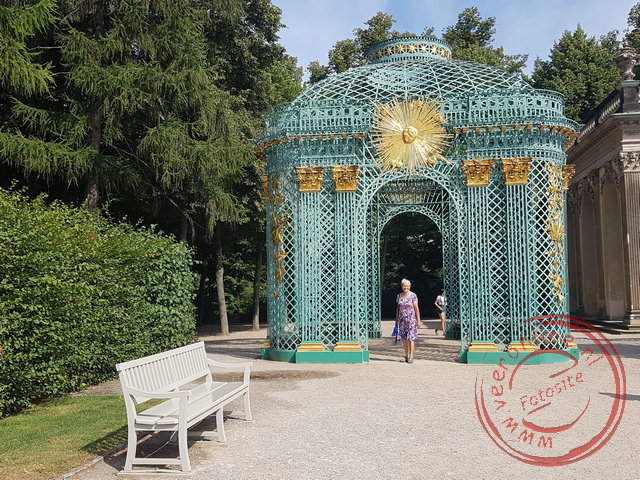 The royal pavilion in the garden of Sanssouci Palace
 King Frederick had a small summer palace built in 1745
 The Charlottenburg palace in the district of the same name