
154 countries
(and areas)
 - Belize
- Benin
- Bhutan
- Bolivia
- Bonaire
- Bosnia and Herzegovina
- Botswana
- Brazil
- British Virgin Islands
- Brunei
- Bulgaria
- Cambodia
- Canada
- Cape Verde
- Chile
- China
- Costa Rica
- Croatia
- Cuba
- Curacao
- Cyprus
- Czech Republic
- Denmark
- Dominica
- Dominican Republic
- Egypt
- El Salvador
- England
- Estonia
- Eswatini (Swaziland)
- Ethiopia
- Fiji
- Finland
- France
- French Guiana
- Georgia
- Germany
- Gibraltar
- Greece
- Grenada
- Guadeloupe
- Guatemala
- Honduras
- Hong Kong
- Hungary
- Iceland
- India
- Indonesia
- Iran
- Ireland
- Israel
- Italy
- Jamaica
- Japan
- Jordan
- Kazakhstan
- Kenya
- Kosovo
- Kuwait
- Kyrgyzstan
- Laos
- Latvia
- Lebanon
- Lesotho
- Liechtenstein
- Lithuania
- Luxembourg
- Macau
- Madagascar
- Malawi
- Malaysia
- Maldives
- Malta
- Martinique
- Mexico
- Moldova
- Monaco
- Mongolia
- Montenegro
- Morocco
- Mozambique
- Namibia
- Nepal
- Netherlands
- New Zealand
- Nicaragua
- North Macedonia
- Northern Ireland
- Norway
- Oman
- Pakistan
- Palestine
- Peru
- Philippines
- Poland
- Portugal
- Qatar
- Republic of Korea
- Romania
- Russia
- Saint Kitts and Nevis
- Saint Lucia
- Saint Martin
- Saint Vincent and the Grenadines
- San Marino
- São Tomé and Principe
- Saudi Arabia
- Scotland
- Senegal
- Serbia
- Singapore
- Sint Maarten
- Slovakia
- Slovenia
- South Africa
- Spain
- Sri Lanka
- Suriname
- Sweden
- Switzerland
- Tajikistan
- Tanzania
- Thailand
- The Gambia
- Tibet
- Togo
- Transnistria
- Trinidad and Tobago
- Tunisia
- Turkey
- Turkmenistan
- Uganda
- United Arab Emirates
- United States
- Uruguay
- Uzbekistan
- Vatican City
- Vietnam
- Wales
- Zambia
- Zanzibar
- Belize
- Benin
- Bhutan
- Bolivia
- Bonaire
- Bosnia and Herzegovina
- Botswana
- Brazil
- British Virgin Islands
- Brunei
- Bulgaria
- Cambodia
- Canada
- Cape Verde
- Chile
- China
- Costa Rica
- Croatia
- Cuba
- Curacao
- Cyprus
- Czech Republic
- Denmark
- Dominica
- Dominican Republic
- Egypt
- El Salvador
- England
- Estonia
- Eswatini (Swaziland)
- Ethiopia
- Fiji
- Finland
- France
- French Guiana
- Georgia
- Germany
- Gibraltar
- Greece
- Grenada
- Guadeloupe
- Guatemala
- Honduras
- Hong Kong
- Hungary
- Iceland
- India
- Indonesia
- Iran
- Ireland
- Israel
- Italy
- Jamaica
- Japan
- Jordan
- Kazakhstan
- Kenya
- Kosovo
- Kuwait
- Kyrgyzstan
- Laos
- Latvia
- Lebanon
- Lesotho
- Liechtenstein
- Lithuania
- Luxembourg
- Macau
- Madagascar
- Malawi
- Malaysia
- Maldives
- Malta
- Martinique
- Mexico
- Moldova
- Monaco
- Mongolia
- Montenegro
- Morocco
- Mozambique
- Namibia
- Nepal
- Netherlands
- New Zealand
- Nicaragua
- North Macedonia
- Northern Ireland
- Norway
- Oman
- Pakistan
- Palestine
- Peru
- Philippines
- Poland
- Portugal
- Qatar
- Republic of Korea
- Romania
- Russia
- Saint Kitts and Nevis
- Saint Lucia
- Saint Martin
- Saint Vincent and the Grenadines
- San Marino
- São Tomé and Principe
- Saudi Arabia
- Scotland
- Senegal
- Serbia
- Singapore
- Sint Maarten
- Slovakia
- Slovenia
- South Africa
- Spain
- Sri Lanka
- Suriname
- Sweden
- Switzerland
- Tajikistan
- Tanzania
- Thailand
- The Gambia
- Tibet
- Togo
- Transnistria
- Trinidad and Tobago
- Tunisia
- Turkey
- Turkmenistan
- Uganda
- United Arab Emirates
- United States
- Uruguay
- Uzbekistan
- Vatican City
- Vietnam
- Wales
- Zambia
- Zanzibar


Copyright 2004 - 2026
Veeronline.nl Travel Adventures
Home > Germany > City Trip Berlin > Travelogue day 3
Travelogue City Trip Berlin
July 31 August 5 2020 (6 days)
Germany > Cycling through Tiergarten
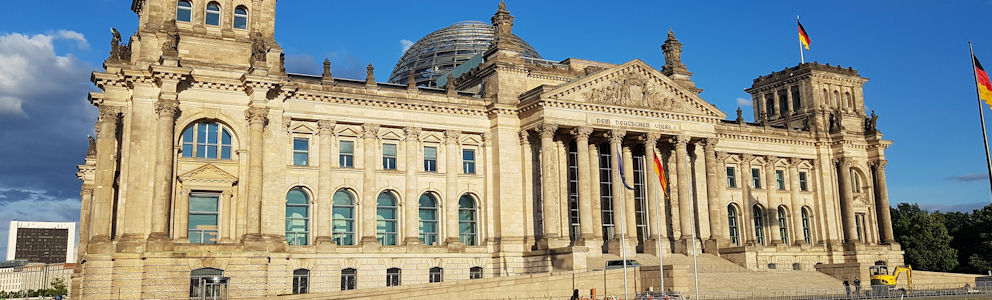
Dag 3 - Sunday 2 August 2020We put our face masks back on to go to breakfast. In the hotel, it is mandatory to wear face coverings. We try the staircase on the other side of our room. Yesterday we took the stairs at the end of the corridor. That led us to the breakfast room, but all exits back to the hotel were locked. Eventually, we found one door that could be opened to go outside. Today, we have no success either. The door on the ground floor leads directly outside. The doors behind us are one-way. There is no way back. We walk back into the hotel via the main entrance. In the breakfast room, we are assigned a table. Bread rolls are already on the table. At the buffet, we can help ourselves to toppings, fruit, and eggs. One-way traffic applies around the buffet. We start talking with the people next to us. They clearly dislike having to wear a face mask. They are in Berlin because of yesterday’s demonstration. They are pleased that the Dutch media reported tens of thousands of participants. In Germany, the number is hardly mentioned in the media, they sigh. According to them, there were even more than a hundred thousand demonstrators against the mandatory 1.5-meter distancing law. After breakfast, we rent two bicycles at the reception. We cycle into the city. Along the Spree River, we first ride a short distance eastward. Soon we enter Museum Island. It is Sunday morning, and the streets are extremely quiet. On Museum Island, stalls for an antique market are being set up. Via the Berlin Cathedral, we cycle back to Unter den Linden. Now, by the Spree River, we head the other way. We want to take a bike ride through Tiergarten Park. Along the riverbank, we see the Reichstag across the water. Many runners run along the river. On both sides stand buildings of the federal government. A pedestrian bridge over the river connects the buildings for parliamentarians. At the Bundes-Abgeordneten-Schlange, an apartment complex specially built for German representatives when Berlin became the capital in 1990 instead of Bonn, we cross the river. We cycle toward the Siegessäule. This striking “Victory Column” was built in 1874 to honor the Prussian victory over the Danes. The column is 67 meters high, and at the top stands the bronze statue of Victoria, the goddess of victory. We lock the bikes and walk to the Siegessäule. On the first floor is a collection of models of monuments both domestic and abroad: the Reichstag, the Monument to the Battle of the Nations in Leipzig, Notre Dame, the Colosseum, and the Statue of Liberty. One floor higher is an open circular walkway. The wall is decorated with glass mosaics depicting battle scenes. Here also starts the spiral staircase to the top of the Siegessäule.

Because social distancing is not possible on the stairs, wearing a mask is mandatory. I soon notice this is a handicap climbing the 285 steps. When no one passes, I sneak a little with the mask. At the top of the column, I have a view over the entire Tiergarten park. In the distance, I see Museum Island, the Berlin Cathedral, and, of course, the 368-meter-high Fernsehturm. We continue cycling. In the western corner of the park, behind the zoo, we find a cozy terrace by a small lock. We order coffee. While sitting under the shelter, it starts to drizzle. The drizzle soon turns to rain. The forecast said the weather would worsen mainly this afternoon. Hopefully, it will dry up quickly because we are on the opposite side of the park, several kilometers from the hotel. While waiting, we order something to eat for lunch. Since we are here anyway, we abandon the plan to cycle to Charlottenburg Palace this afternoon. The metro is a safer option. Around half past twelve, it seems a bit drier, but not completely dry. We take a chance. Through the park, we cycle back to the hotel. On the way, we still get quite wet. We exit the park at the Brandenburg Gate. There is another demonstration going on. It seems again against the government’s corona measures. This time, there are at most a thousand people gathered in the rain. We quickly pass them, ride under the city gate, and continue to our hotel. In the room, we change into something dry. The S-Bahn metro station is opposite the hotel. At the ticket machine, we buy two tickets. The tickets are valid for two hours on both the S-Bahn and U-Bahn. To get to Charlottenburg Palace, we have to transfer at Zoologischer Garten. I had the third stop in mind. When we get off and look for the U-Bahn, it turns out we are at the Tiergarten stop. No transfer is possible here. We go back on the S-Bahn and travel one more stop. Luckily, we have enough time. At half past two, we have tickets for Charlottenburg Palace. We take the metro three stops toward the palace. From there, it’s a short walk. A young man points us in the right direction. After a few minutes, we check the route on the phone, and it turns out we are going the exact wrong way. We cannot blame the young man; he sent us in the direction of the Charlottenburg neighborhood. However, Charlottenburg Palace lies in the opposite direction.

We quickly turn around and pick up the pace. Will we still be on time? At three minutes past half past two, we arrive at the entrance. There is a line of waiting visitors. How would the time slot system work? It quickly becomes clear there are still people in the queue with earlier time slots. We just have to wait at the back. Maybe thirty people are waiting. Not that many, but only a few people are admitted at a time. Only when visitors leave the palace, new people are allowed in. We patiently wait our turn. After half an hour, we are allowed inside. The palace was built in 1695 by order of Sophie Charlotte, wife of Elector Frederick III, who later crowned himself King Frederick I. The palace was initially called Lietzenburg. Only after Sophie Charlotte’s death in 1705 was the palace named after her. During World War II, Charlottenburg Palace was heavily damaged by bombing. Fortunately, it has been restored to its original state. Immediately upon entering, we see the beautiful rooms: the Green Mirror Room, the reception rooms, the bedrooms, and the highlight—the Porcelain Room with thousands of Delft Blue porcelain objects. After the old palace, we also visit the new wing, added in 1740. The two large ballrooms full of golden decorations are impressive. The other rooms are also each remarkable, but we become saturated by all the splendor. Behind the palace, we stroll through the beautifully landscaped garden. The large park behind the palace is designed following the Versailles style. It is five o’clock when we order a beer in the street in front of Charlottenburg Palace. While enjoying the drink, we look back on a beautiful day in Berlin. However, we still have to return. We walk through Schlossstrasse back to the metro. We see the sign for the U-Bahn but not the entrance. It turns out this station is closed for maintenance. We have to go to the next station. By metro and S-Bahn, we get off at Hackescher Markt. This stop is one stop past Friedrichstrasse. At Hackescher Markt, there are several nice terraces. The entire square in front of the station consists of terraces from restaurants. We choose a cozy terrace at a restaurant and, to be safe, a table under a parasol. We are unsure if it will stay dry. Luckily, it does. After dinner, we walk via Museum Island back to the hotel. Around the museums, it is busy. Young people dance to music, and others drink their own beer brought to the edge of the Spree River.

 Germany
  Eating on a terrace on the Spree river
 The famous Brandenburg Gate in Berlin
 One of the museums on Museum Island in Berlin
 An original watchtower of the border between East and West Berlin