
154 countries
(and areas)
 - Belize
- Benin
- Bhutan
- Bolivia
- Bonaire
- Bosnia and Herzegovina
- Botswana
- Brazil
- British Virgin Islands
- Brunei
- Bulgaria
- Cambodia
- Canada
- Cape Verde
- Chile
- China
- Costa Rica
- Croatia
- Cuba
- Curacao
- Cyprus
- Czech Republic
- Denmark
- Dominica
- Dominican Republic
- Egypt
- El Salvador
- England
- Estonia
- Eswatini (Swaziland)
- Ethiopia
- Fiji
- Finland
- France
- French Guiana
- Georgia
- Germany
- Gibraltar
- Greece
- Grenada
- Guadeloupe
- Guatemala
- Honduras
- Hong Kong
- Hungary
- Iceland
- India
- Indonesia
- Iran
- Ireland
- Israel
- Italy
- Jamaica
- Japan
- Jordan
- Kazakhstan
- Kenya
- Kosovo
- Kuwait
- Kyrgyzstan
- Laos
- Latvia
- Lebanon
- Lesotho
- Liechtenstein
- Lithuania
- Luxembourg
- Macau
- Madagascar
- Malawi
- Malaysia
- Maldives
- Malta
- Martinique
- Mexico
- Moldova
- Monaco
- Mongolia
- Montenegro
- Morocco
- Mozambique
- Namibia
- Nepal
- Netherlands
- New Zealand
- Nicaragua
- North Macedonia
- Northern Ireland
- Norway
- Oman
- Pakistan
- Palestine
- Peru
- Philippines
- Poland
- Portugal
- Qatar
- Republic of Korea
- Romania
- Russia
- Saint Kitts and Nevis
- Saint Lucia
- Saint Martin
- Saint Vincent and the Grenadines
- San Marino
- São Tomé and Principe
- Saudi Arabia
- Scotland
- Senegal
- Serbia
- Singapore
- Sint Maarten
- Slovakia
- Slovenia
- South Africa
- Spain
- Sri Lanka
- Suriname
- Sweden
- Switzerland
- Tajikistan
- Tanzania
- Thailand
- The Gambia
- Tibet
- Togo
- Transnistria
- Trinidad and Tobago
- Tunisia
- Turkey
- Turkmenistan
- Uganda
- United Arab Emirates
- United States
- Uruguay
- Uzbekistan
- Vatican City
- Vietnam
- Wales
- Zambia
- Zanzibar
- Belize
- Benin
- Bhutan
- Bolivia
- Bonaire
- Bosnia and Herzegovina
- Botswana
- Brazil
- British Virgin Islands
- Brunei
- Bulgaria
- Cambodia
- Canada
- Cape Verde
- Chile
- China
- Costa Rica
- Croatia
- Cuba
- Curacao
- Cyprus
- Czech Republic
- Denmark
- Dominica
- Dominican Republic
- Egypt
- El Salvador
- England
- Estonia
- Eswatini (Swaziland)
- Ethiopia
- Fiji
- Finland
- France
- French Guiana
- Georgia
- Germany
- Gibraltar
- Greece
- Grenada
- Guadeloupe
- Guatemala
- Honduras
- Hong Kong
- Hungary
- Iceland
- India
- Indonesia
- Iran
- Ireland
- Israel
- Italy
- Jamaica
- Japan
- Jordan
- Kazakhstan
- Kenya
- Kosovo
- Kuwait
- Kyrgyzstan
- Laos
- Latvia
- Lebanon
- Lesotho
- Liechtenstein
- Lithuania
- Luxembourg
- Macau
- Madagascar
- Malawi
- Malaysia
- Maldives
- Malta
- Martinique
- Mexico
- Moldova
- Monaco
- Mongolia
- Montenegro
- Morocco
- Mozambique
- Namibia
- Nepal
- Netherlands
- New Zealand
- Nicaragua
- North Macedonia
- Northern Ireland
- Norway
- Oman
- Pakistan
- Palestine
- Peru
- Philippines
- Poland
- Portugal
- Qatar
- Republic of Korea
- Romania
- Russia
- Saint Kitts and Nevis
- Saint Lucia
- Saint Martin
- Saint Vincent and the Grenadines
- San Marino
- São Tomé and Principe
- Saudi Arabia
- Scotland
- Senegal
- Serbia
- Singapore
- Sint Maarten
- Slovakia
- Slovenia
- South Africa
- Spain
- Sri Lanka
- Suriname
- Sweden
- Switzerland
- Tajikistan
- Tanzania
- Thailand
- The Gambia
- Tibet
- Togo
- Transnistria
- Trinidad and Tobago
- Tunisia
- Turkey
- Turkmenistan
- Uganda
- United Arab Emirates
- United States
- Uruguay
- Uzbekistan
- Vatican City
- Vietnam
- Wales
- Zambia
- Zanzibar


Copyright 2004 - 2026
Veeronline.nl Travel Adventures

Home > Sri Lanka > Sri Lanka and the Maldives > Travelogue day 5
Travelogue Sri Lanka and the Maldives
October 20 November 10 2015 (20 days)
Sri Lanka > The Lion Rock of Sigiriya
Dag 5 - Monday, October 26, 2015The day begins with a tentative bit of sunshine. That’s good, because today I’m going to visit the ancient palace of Sigiriya. The remnants of this palace sit atop the Lion Rock, a steep 200-meter-high rock formation. At the entrance, the guide introduces himself with an unpronounceable name. “Just call me Cherry,” he says—it’s easier. Cherry takes me through the complex. I stroll past the water garden: four symmetrically laid-out pools. Water flows from higher basins through a system of pipes. During heavy rainfall, the water pressure shoots water up through the manhole covers with small openings, creating a kind of fountain. In the distance, Lion Rock rises majestically. The Sigiriya palace was built in 477 AD by order of King Kassapa. To gain power, he had overthrown and killed his father, King Dhatusena. Fearing that the rightful heir, his half-brother Mogallana, would retaliate, he chose the steep rock as a strategic location for his palace.

To access the summit, he had a massive lion’s head constructed from bricks. To enter, one had to pass through the lion’s mouth, giving the complex its name: Sigiriya, or Lion Rock. The fortifications didn’t help much. During a battle, Kassapa was on the verge of defeat and committed suicide. The Sigiriya complex served as a palace for only 18 years before being returned to the monks. At the base of the enormous rock, I stand in the rock garden, which leads into the terraced garden. There were once several caves here for the monks, decorated with frescoes. Cherry shows me a few remnants. From here, the staircase to the top begins. I climb a partially marble staircase, as it was originally, partially replaced by iron steps. There are many tourists ahead of me—it’s busy. Through a narrow iron spiral staircase, I reach the Maiden’s Cave. The frescoes in this cave are well preserved and restored. Numerous depictions of women adorn the rock walls. Passing the Mirror Wall, a polished wall of lime, egg white, and beeswax, I reach the second plateau. Here I see the original entrance gate—only the lion’s claws have withstood the test of time. Judging from the size of the claws, the lion’s head must have been impressive. Today, an iron staircase is attached to the rock, leading to the upper plateau. At the top, I see the remains of the palace foundations, terraces, and a water pool. The view from Lion Rock is stunning.

Despite the somewhat hazy weather, I can see far in all directions. Cherry points out the directions of Anuradhapura, Polonnaruwa, and Kandy. Back down, I ask Ajbriy if it’s possible to also climb the nearby Pidurangala. He looks hesitant and advises against it, as the path can be dangerously slippery. We decide to drive to the temple at the base of the hill. To visit the temple, I need to buy a ticket that also covers the cave on the mountain. A local guide assures me the path is perfectly manageable. I decide to take the chance. The local guide introduces himself as Sunil and leads me upwards. Unlike Sigiriya, there are no restored steps here; the path consists of uneven stone steps. Carefully, I climb from stone to stone. Descending tourists—all Dutch—assure me it’s quite doable to reach the top. After about twenty-five minutes of climbing, I arrive at the Reclining Buddha cave. This site was also established by King Kassapa, as a concession to the monks who resided on Sigiriya Rock, Sunil explains. The final stretch to the summit is rougher. I climb from stone to stone, with Sunil occasionally lending a hand. The view from the top is magnificent. I see Lion Rock rising from the lower jungle. Incredible! I return down in time. Ajbriy had worried that I wouldn’t have time for lunch and the afternoon walk, but I wouldn’t have missed this for anything. He quickly drives me to a restaurant for lunch, where I choose a sandwich. After lunch, I transfer to an off-road vehicle and drive a short distance along the main road. I take my umbrella, just in case, as dark clouds approach from the right. Roshan is my guide for this walk. He explains about the trees, fruits, and birds.

His English is limited. He says he wants to practice English, though it’s hard to tell if he understands me because he always replies “yes.” I walk along a dirt path past some remote houses in the village of Harabara. Children wave enthusiastically. I practice the words “Ayubowan” (welcome) and “Istuti” (thank you). Sri Lankan is a difficult language. Just as I turn onto a narrow path along the rice fields, it starts to rain. With my umbrella, I walk toward the lake. From there, I can see Sigiriya Rock and Pidurangala in the distance. The rain intensifies. When I want to return to the main road, I notice a sign: “Kassapa Lions Rock Resort.” I’m only 200 meters from my lodge. I indicate to Roshan that I’d prefer to walk straight to the lodge. He feels uneasy and suggests we first go to the main road, where the vehicle is waiting. I have no interest in that. After some calls, the off-road vehicle arrives. Both Roshan and the driver are unsure about the change in plan. I, however, know what I want and ask them to drop me at the lodge. I also have Ajbriy contacted through the reception, explaining that I’m already at the lodge. He arrives about half an hour later, and we meet at the bar to discuss tomorrow’s program. It’s still raining as I walk to my cottage. I have a cabin with an open-air shower—meaning I shower outdoors, with only mesh overhead to keep insects out. There’s something special about showering in the rain.
 Sri Lanka
 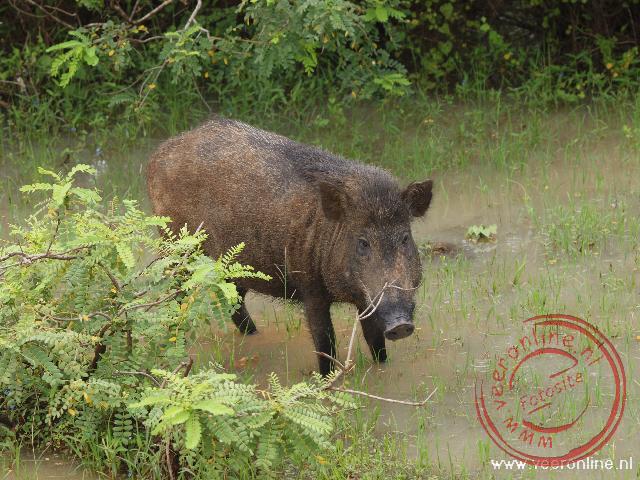 A wild pig watches its surroundings
 A gray langur monkey in Yala NP
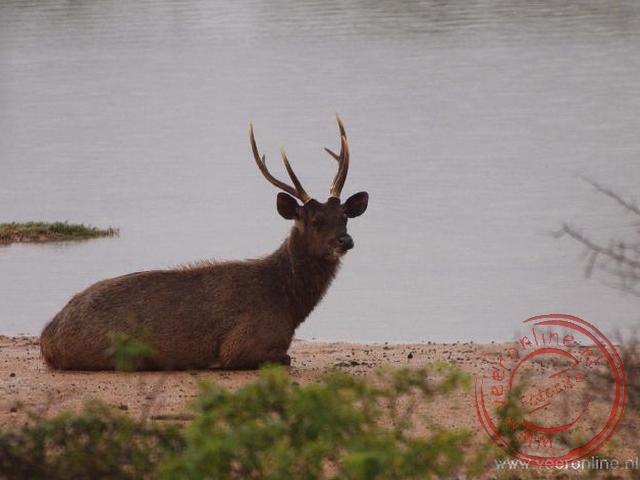 A Samba deer rests by the water
 A white heron and an ibis
Travelogue Sri Lanka and the Maldives
Dag 2 | Sri Lanka > Buying clothes in Negombo
Dag 3 | Sri Lanka > The Dutch Canal
Dag 4 | Sri Lanka > Elephants in Pinnawela
Dag 5 | Sri Lanka > The Lion Rock of Sigiriya
Dag 6 | Sri Lanka > Rain in Polonnaruwa
Dag 7 | Sri Lanka > From Dambulla to Kandy
Dag 8 | Sri Lanka > The Three Temple Loop near Kandy
Dag 9 | Sri Lanka > By train to Naru Oye
Dag 10 | Sri Lanka > Horton Plains National Park
Dag 11 | Sri Lanka > The temple of Buduruyagala
Dag 12 | Sri Lanka > The temple of Kataragama
Dag 13 | Sri Lanka > Wildlife spotting in Yala N.P.
Dag 14 | Sri Lanka > Sightseeing Colombo
Dag 15 | Sri Lanka > On the way to the Maldives
Dag 16 | Maldives > Enjoying paradise
Dag 17 | Maldives > Rain in the Maldives
Dag 18 | Maldives > Nice relaxing
Dag 19 | Maldives > Farewell to the Maldives
Dag 20 | Maldives > Back home