
154 countries
(and areas)
 - Belize
- Benin
- Bhutan
- Bolivia
- Bonaire
- Bosnia and Herzegovina
- Botswana
- Brazil
- British Virgin Islands
- Brunei
- Bulgaria
- Cambodia
- Canada
- Cape Verde
- Chile
- China
- Costa Rica
- Croatia
- Cuba
- Curacao
- Cyprus
- Czech Republic
- Denmark
- Dominica
- Dominican Republic
- Egypt
- El Salvador
- England
- Estonia
- Eswatini (Swaziland)
- Ethiopia
- Fiji
- Finland
- France
- French Guiana
- Georgia
- Germany
- Gibraltar
- Greece
- Grenada
- Guadeloupe
- Guatemala
- Honduras
- Hong Kong
- Hungary
- Iceland
- India
- Indonesia
- Iran
- Ireland
- Israel
- Italy
- Jamaica
- Japan
- Jordan
- Kazakhstan
- Kenya
- Kosovo
- Kuwait
- Kyrgyzstan
- Laos
- Latvia
- Lebanon
- Lesotho
- Liechtenstein
- Lithuania
- Luxembourg
- Macau
- Madagascar
- Malawi
- Malaysia
- Maldives
- Malta
- Martinique
- Mexico
- Moldova
- Monaco
- Mongolia
- Montenegro
- Morocco
- Mozambique
- Namibia
- Nepal
- Netherlands
- New Zealand
- Nicaragua
- North Macedonia
- Northern Ireland
- Norway
- Oman
- Pakistan
- Palestine
- Peru
- Philippines
- Poland
- Portugal
- Qatar
- Republic of Korea
- Romania
- Russia
- Saint Kitts and Nevis
- Saint Lucia
- Saint Martin
- Saint Vincent and the Grenadines
- San Marino
- São Tomé and Principe
- Saudi Arabia
- Scotland
- Senegal
- Serbia
- Singapore
- Sint Maarten
- Slovakia
- Slovenia
- South Africa
- Spain
- Sri Lanka
- Suriname
- Sweden
- Switzerland
- Tajikistan
- Tanzania
- Thailand
- The Gambia
- Tibet
- Togo
- Transnistria
- Trinidad and Tobago
- Tunisia
- Turkey
- Turkmenistan
- Uganda
- United Arab Emirates
- United States
- Uruguay
- Uzbekistan
- Vatican City
- Vietnam
- Wales
- Zambia
- Zanzibar
- Belize
- Benin
- Bhutan
- Bolivia
- Bonaire
- Bosnia and Herzegovina
- Botswana
- Brazil
- British Virgin Islands
- Brunei
- Bulgaria
- Cambodia
- Canada
- Cape Verde
- Chile
- China
- Costa Rica
- Croatia
- Cuba
- Curacao
- Cyprus
- Czech Republic
- Denmark
- Dominica
- Dominican Republic
- Egypt
- El Salvador
- England
- Estonia
- Eswatini (Swaziland)
- Ethiopia
- Fiji
- Finland
- France
- French Guiana
- Georgia
- Germany
- Gibraltar
- Greece
- Grenada
- Guadeloupe
- Guatemala
- Honduras
- Hong Kong
- Hungary
- Iceland
- India
- Indonesia
- Iran
- Ireland
- Israel
- Italy
- Jamaica
- Japan
- Jordan
- Kazakhstan
- Kenya
- Kosovo
- Kuwait
- Kyrgyzstan
- Laos
- Latvia
- Lebanon
- Lesotho
- Liechtenstein
- Lithuania
- Luxembourg
- Macau
- Madagascar
- Malawi
- Malaysia
- Maldives
- Malta
- Martinique
- Mexico
- Moldova
- Monaco
- Mongolia
- Montenegro
- Morocco
- Mozambique
- Namibia
- Nepal
- Netherlands
- New Zealand
- Nicaragua
- North Macedonia
- Northern Ireland
- Norway
- Oman
- Pakistan
- Palestine
- Peru
- Philippines
- Poland
- Portugal
- Qatar
- Republic of Korea
- Romania
- Russia
- Saint Kitts and Nevis
- Saint Lucia
- Saint Martin
- Saint Vincent and the Grenadines
- San Marino
- São Tomé and Principe
- Saudi Arabia
- Scotland
- Senegal
- Serbia
- Singapore
- Sint Maarten
- Slovakia
- Slovenia
- South Africa
- Spain
- Sri Lanka
- Suriname
- Sweden
- Switzerland
- Tajikistan
- Tanzania
- Thailand
- The Gambia
- Tibet
- Togo
- Transnistria
- Trinidad and Tobago
- Tunisia
- Turkey
- Turkmenistan
- Uganda
- United Arab Emirates
- United States
- Uruguay
- Uzbekistan
- Vatican City
- Vietnam
- Wales
- Zambia
- Zanzibar


Copyright 2004 - 2026
Veeronline.nl Travel Adventures

Home > Bahrain > Qatar Bahrain and Kuwait > Travelogue day 4
Travelogue Qatar Bahrain and Kuwait
January 314 2025 (12 days)
Bahrain > The Bahrain F1 Circuit
Dag 4 - Monday, January 6, 2025I quite liked having breakfast in the cabin yesterday. So I ordered it again for between 7:45 and 8:00. Half an hour earlier, my alarm goes off. Just as I’m about to take a shower, there’s a knock at the door. Breakfast has arrived early. No problem, I’ll eat first. I do wonder what they do if I’d already been in the shower? I still find it too chilly on the balcony, so I eat my breakfast inside while the ship docks at the port of Bahrain. At 8:45, I report to the theater for today’s excursion. When bus 45 is announced, I go outside. I’m welcomed by a reception committee. I’m offered Bahraini sweets and a small cup of tea. Someone is also ready with a map of the island. At the bus, I meet Anna and Maroon, the two guides for today. Anna handles the German guests, Maroon gives the English explanations. While the bus leaves the harbor, she explains that Bahrain is only 55 by 18 kilometers—just a bit larger than Texel. Bahrain became independent in December 1971. Even in ancient times, the island was a favored location due to the presence of fresh water sources. The first stop today is the Dilmun burial mounds. These burial mounds are a remarkable archaeological site dating from the early Bronze Age (around 2000 BC). They are scattered across Bahrain and represent one of the largest concentrations of prehistoric burial mounds in the world. The burial mounds are on the World Heritage list. When I look at the mounds, they seem more like a messy construction site. Each grave is covered by an earthen mound about two meters high. As we continue driving, the landscape becomes drier and barer. I notice the red and white Bahraini flag flying frequently.

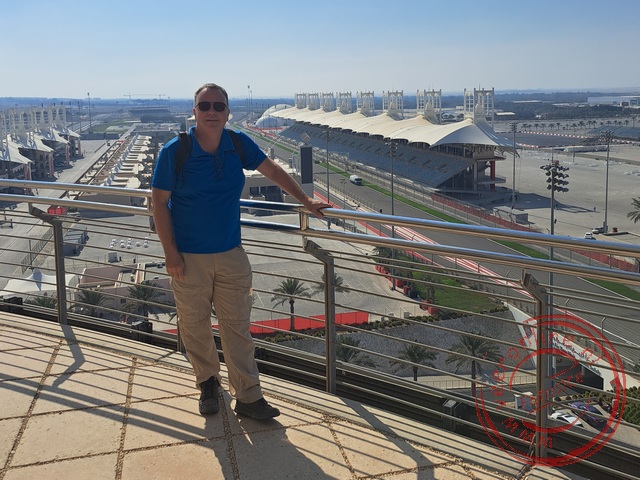
Practically every lamppost has one. Flags also hang from houses or strings of small flags. Maroon says the flag has five serrated edges. Her explanation of how this relates to Islam is a bit lost on me—or seems a bit far-fetched. We arrive at the king’s camel farm. Here, the camels are trained for races. We can walk among some of the camels but are warned not to get too close. Sometimes camels mistake hair for food. Everyone safely returns to the bus. Next, we drive to the Bahrain International Circuit—the Formula 1 race track in the desert. Since 2004, Bahrain has hosted Formula 1 races. This year marks the twentieth race. Only in 2011 was the race canceled due to political tensions surrounding the Arab Spring. Max Verstappen has won the last two races here. In a few weeks, he’ll have another chance. The first stop is the VIP Tower. From the eighth floor, I can see the circuit and the pit lane. It’s more interesting than I expected. We also visit the media center—the space where the press stays during the race. Next door is the control room. On dozens of screens, every part of the circuit can be watched. Footage can also be reviewed here if accidents occur. Maroon says that turn one especially gets a lot of attention because something always happens there right after the start. After the control room, we get to look at the pit lane and the circuit itself. How special is it to stand on the finish line! After visiting the circuit, we return to Manama, the capital of Bahrain.
The country has 1.8 million inhabitants, most of whom live in the capital. We have an hour to stroll through the Manama souq. Vendors immediately want to know where I’m from. They all come from India. I make a deal with one vendor: for two dollars, I exchange a Bahraini banknote. It’s a good deal for him because the value is just twenty cents. Now I have another Bahraini banknote for my collection. I walk a bit outside the tourist streets. Sometimes I wonder if a street is a dead end or if there is a passage. I follow a woman who seems familiar. A little later, she asks if I’m also “lost.” She has parked her car but doesn’t remember where. For me, it’s easier—the bus is parked in the lot in front of the Bahrain Financial Harbour building. This is the tallest building in Bahrain and easy to spot. Once everyone is back on the bus, we head to the last stop for today: the Al-Fatah Grand Mosque. Construction began in 1984, and it’s the largest mosque in the country. It can accommodate 7,000 worshippers. A mosque guide gives a talk about the Al-Fatah Mosque. Actually, she mostly talks about Islam and why some customs take place—for example, praying five times a day, the fasting month, and the separate praying for men and women. Essentially, it all comes down to it being easier that way.

From the mosque, it’s still a half-hour drive through busy traffic back to the port. The distance itself is just eleven kilometers. Around 3:15 p.m., I’m back at the ship. I notice I’m hungry—I haven’t eaten anything all day. I go to the Market Buffet on deck 15. I pick out some food but keep the amount small. In a few hours, I’ll eat again. Around me, I see people eating impressive amounts. I order a glass of wine and go to my cabin. The sun is still shining on my cabin. On the balcony, I enjoy the last rays of the day. At dinner, I sit next to a mixed German and Russian couple. She only speaks Russian; I don’t. The man seems to prefer talking to me rather than his girlfriend. Fortunately for her, some Russian guests arrive on the other side. Where the courses were served quickly in succession yesterday, tonight it goes slower. I even have to hurry to finish my dessert. At nine o’clock, the show starts in the theater. In the past few days, I had enough time to order coffee in between. Now I go straight to the theater. It’s on the same deck but on the completely opposite side of the ship. Tonight, the show is fully booked again. Luckily, I made a reservation. Tonight’s program features rock music. Once again, the dance and singing group puts on a spectacular show. I think it’s the best performance so far. At the end, it is announced that tonight the clock will go back to Dubai time. This means the clock will move forward one hour.
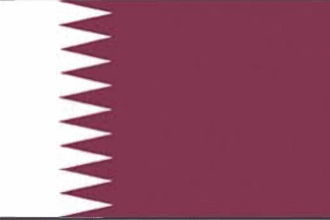 Qatar
Qatar  The expansive Souq Waqif in Doha
 United Arab Emirates
  Kite Beach in Dubai
 Kuwait
 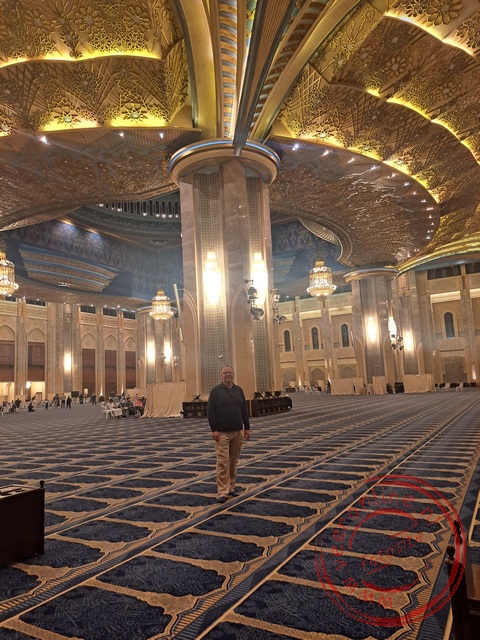 The mosque dome rests on four large pillars
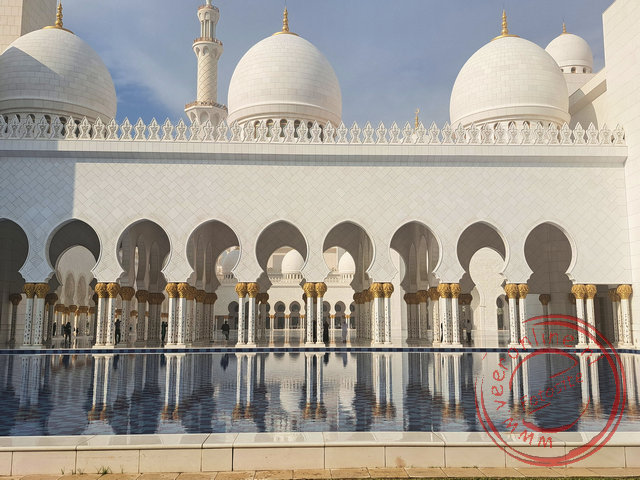 The Sheikh Zayed mosque has over a thousand pillars
Travelogue Qatar Bahrain and Kuwait
Dag 2 | United Arab Emirates > On board the MSC Euribia
Dag 3 | Qatar > Cycling through Doha
Dag 4 | Bahrain > The Bahrain F1 Circuit
Dag 5 | United Arab Emirates > A day on board
Dag 6 | United Arab Emirates > The Abu Dhabi Mosque
Dag 7 | United Arab Emirates > Safari on Sir Bani Yas
Dag 8 | United Arab Emirates > Cycling to the Burj al Arab
Dag 9 | Kuwait > Flight to Kuwait
Dag 10 | Kuwait > The consequences of the Iraq War
Dag 11 | Kuwait > Tour of Kuwait City
Dag 12 | Kuwait > Via Dubai back home