
154 countries
(and areas)
 - Belize
- Benin
- Bhutan
- Bolivia
- Bonaire
- Bosnia and Herzegovina
- Botswana
- Brazil
- British Virgin Islands
- Brunei
- Bulgaria
- Cambodia
- Canada
- Cape Verde
- Chile
- China
- Costa Rica
- Croatia
- Cuba
- Curacao
- Cyprus
- Czech Republic
- Denmark
- Dominica
- Dominican Republic
- Egypt
- El Salvador
- England
- Estonia
- Eswatini (Swaziland)
- Ethiopia
- Fiji
- Finland
- France
- French Guiana
- Georgia
- Germany
- Gibraltar
- Greece
- Grenada
- Guadeloupe
- Guatemala
- Honduras
- Hong Kong
- Hungary
- Iceland
- India
- Indonesia
- Iran
- Ireland
- Israel
- Italy
- Jamaica
- Japan
- Jordan
- Kazakhstan
- Kenya
- Kosovo
- Kuwait
- Kyrgyzstan
- Laos
- Latvia
- Lebanon
- Lesotho
- Liechtenstein
- Lithuania
- Luxembourg
- Macau
- Madagascar
- Malawi
- Malaysia
- Maldives
- Malta
- Martinique
- Mexico
- Moldova
- Monaco
- Mongolia
- Montenegro
- Morocco
- Mozambique
- Namibia
- Nepal
- Netherlands
- New Zealand
- Nicaragua
- North Macedonia
- Northern Ireland
- Norway
- Oman
- Pakistan
- Palestine
- Peru
- Philippines
- Poland
- Portugal
- Qatar
- Republic of Korea
- Romania
- Russia
- Saint Kitts and Nevis
- Saint Lucia
- Saint Martin
- Saint Vincent and the Grenadines
- San Marino
- São Tomé and Principe
- Saudi Arabia
- Scotland
- Senegal
- Serbia
- Singapore
- Sint Maarten
- Slovakia
- Slovenia
- South Africa
- Spain
- Sri Lanka
- Suriname
- Sweden
- Switzerland
- Tajikistan
- Tanzania
- Thailand
- The Gambia
- Tibet
- Togo
- Transnistria
- Trinidad and Tobago
- Tunisia
- Turkey
- Turkmenistan
- Uganda
- United Arab Emirates
- United States
- Uruguay
- Uzbekistan
- Vatican City
- Vietnam
- Wales
- Zambia
- Zanzibar
- Belize
- Benin
- Bhutan
- Bolivia
- Bonaire
- Bosnia and Herzegovina
- Botswana
- Brazil
- British Virgin Islands
- Brunei
- Bulgaria
- Cambodia
- Canada
- Cape Verde
- Chile
- China
- Costa Rica
- Croatia
- Cuba
- Curacao
- Cyprus
- Czech Republic
- Denmark
- Dominica
- Dominican Republic
- Egypt
- El Salvador
- England
- Estonia
- Eswatini (Swaziland)
- Ethiopia
- Fiji
- Finland
- France
- French Guiana
- Georgia
- Germany
- Gibraltar
- Greece
- Grenada
- Guadeloupe
- Guatemala
- Honduras
- Hong Kong
- Hungary
- Iceland
- India
- Indonesia
- Iran
- Ireland
- Israel
- Italy
- Jamaica
- Japan
- Jordan
- Kazakhstan
- Kenya
- Kosovo
- Kuwait
- Kyrgyzstan
- Laos
- Latvia
- Lebanon
- Lesotho
- Liechtenstein
- Lithuania
- Luxembourg
- Macau
- Madagascar
- Malawi
- Malaysia
- Maldives
- Malta
- Martinique
- Mexico
- Moldova
- Monaco
- Mongolia
- Montenegro
- Morocco
- Mozambique
- Namibia
- Nepal
- Netherlands
- New Zealand
- Nicaragua
- North Macedonia
- Northern Ireland
- Norway
- Oman
- Pakistan
- Palestine
- Peru
- Philippines
- Poland
- Portugal
- Qatar
- Republic of Korea
- Romania
- Russia
- Saint Kitts and Nevis
- Saint Lucia
- Saint Martin
- Saint Vincent and the Grenadines
- San Marino
- São Tomé and Principe
- Saudi Arabia
- Scotland
- Senegal
- Serbia
- Singapore
- Sint Maarten
- Slovakia
- Slovenia
- South Africa
- Spain
- Sri Lanka
- Suriname
- Sweden
- Switzerland
- Tajikistan
- Tanzania
- Thailand
- The Gambia
- Tibet
- Togo
- Transnistria
- Trinidad and Tobago
- Tunisia
- Turkey
- Turkmenistan
- Uganda
- United Arab Emirates
- United States
- Uruguay
- Uzbekistan
- Vatican City
- Vietnam
- Wales
- Zambia
- Zanzibar


Copyright 2004 - 2026
Veeronline.nl Travel Adventures

Home > Italy > Northern Italy and San Marino > Travelogue day 7
Travelogue Northern Italy and San Marino
June 24 July 13 2022 (20 days)
Italy > The Leaning Tower of Pisa
Dag 7 - Thursday 30 June 2022We left the door open last night. A fresh breeze came in. It was also wonderful to hear the sound of the waves. Breakfast is at the restaurant called De Lantaarn. The waitress speaks hardly any English, which makes everything seem a bit curt and unfriendly. We try to ignore this and enjoy our breakfast. A preparation for a new walking day. Two Norwegian guests explain how to get to the start of the route to Manarola. There used to be a path right along the coast, but due to landslides, this path has been closed for years. The alternative route goes through the mountains. The route first leads to the mountain village of Volastra and then descends to Manarola. We climb into the mountains via a steep path. Below us, Corniglia is getting smaller. The route passes through vineyards and olive groves. After an hour and a half, we reach Volastra. This village lies on top of the mountain. We look at the small, simple church. In a little shop, we buy something to drink. It is nice weather today but also very warm. From walkers going in the opposite direction, we learn that we still have quite a descent ahead. The descent is via stairs made of stone. The relatively low steps make it an easy descent. The last part to Manarola goes more over rocks. Here the steps are more natural and irregular in size. Some steps are more than thirty centimeters high. We descend carefully. Around noon, we arrive in Manarola. Around the harbor, it is busy with tourists. Several people are swimming in the bay. Some jump from the high rocks into the sea. Most people who visit Cinque Terre only visit the villages. Each village is easily accessible by train and boat. That way you can visit several fishing villages in one day. For the last leg to Riomaggiore, we also choose the boat. The direct path between Manarola and Riomaggiore was also closed years ago after landslides. There are plans to reopen the path, but this has not yet happened.

The alternative path goes over the mountains and takes several hours. The ferry takes us to Riomaggiore in less than ten minutes. From the sea, you can clearly see how all the houses are stacked on top of each other against the cliff. As in all the other villages, it is busy here too. We order something to eat at a terrace. Around half past two, we are at the station. At the ticket machine, we buy a ticket for the next train back to Levanto. This is the 3 o’clock train. However, on the platform, we find that the previous train is delayed. We could no longer reserve a ticket for it. We decide just to get on. On the way, we pass all the villages of Cinque Terre. Just after three, we get off at Levanto. There was no ticket control. We walk back to our accommodation from yesterday. Our car is there. We set the navigation to Pisa and head off. We spend the night in a room at a monastery. We are allowed to park our car inside the monastery walls. For this, we have to drive to a point in Pisa nearby and then call. This point marks the beginning of the ZTL zone, an area accessible only to permit holders. Because we registered our license plate in advance, we assume we can enter the zone without a fine. At the given point, we call the monastery. The nun explains that we have to turn left and then immediately right. At least, that’s what we think we understand. However, this is against the traffic direction. We go right. We drive through narrow streets of Pisa’s old town. The navigation says we have to go past a street with terraces. Meanwhile, we get a callback. “Where are you now?” We say we are coming from the other side. The navigation sends us into a narrow street. “Does this fit?” A young nun, dressed completely in white, asks if we just called. “You have to go down this street,” she emphasizes. We arrive at the main entrance. A second nun explains that we have to drive right and then left again.

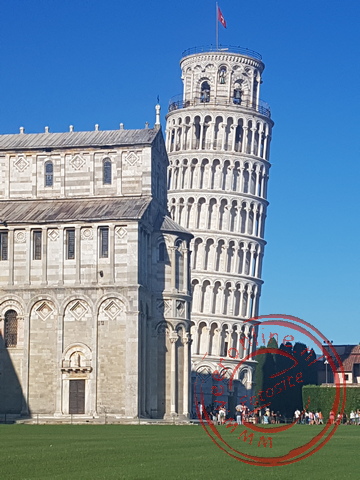
She opens the gate for us. Shortly after, we drive onto the monastery grounds. We are warmly welcomed by the nun we spoke with on the phone. She gives us the key to the room. From the monastery, it’s a twenty-minute walk to the famous tower of Pisa. From a distance, we can already see the 57-meter-high tower. Construction of the bell tower, next to the Cathedral of Pisa, began in 1173. Because of the soft ground, the tower began to lean during construction. For a long time, it was feared the tower would continue to sink and collapse. Today, the tower is firmly supported. Before climbing the tower, we visit the cathedral first. The cathedral, or Duomo di Pisa, was built in 1054 in honor of Mary. The interior is clad in black and white marble. The dome is decorated with frescoes. Much medieval art was lost during the fire of 1595. The coffered ceiling was replaced after the fire. Recently, it has again become possible for tourists to enter the Tower of Pisa. At the entrance, our tickets are scanned and we are checked for weapons. The check is not very strict. Inside the tower, a marble staircase leads upward. The steps are worn down. Because the tower leans four meters off vertical, walking on the circular stairs is tricky. Sometimes you lean forward, left, backward, or right. It feels a bit like a fairground ride or being drunk. Without too much trouble, we climb the 251 steps. From the top, we overlook all of Pisa. A small staircase leads us to the highest platform, where the bells hang. In a street at the foot of the tower, we order something to eat. A beautiful spot with a view of the tower. Slowly, it gets dark. We walk back to our monastery. We take the chairs out of the car and sit for a while in the monastery’s courtyard. It’s a wonderful evening.
 Germany
 Italy
Italy 

Travelogue Northern Italy and San Marino
Dag 2 | Italy > Lake Como
Dag 3 | Italy > Wandering through Nesso
Dag 4 | Italy > The Rolli Palaces of Genoa
Dag 5 | Italy > Monastery of San Fruttuoso
Dag 6 | Italy > The Cinque Terre Fishing Villages
Dag 7 | Italy > The Leaning Tower of Pisa
Dag 8 | Italy > Cycling in Lucca
Dag 9 | Italy > The Duomo of Florence
Dag 10 | Italy > The Pitti Palace
Dag 11 | Italy > Towers of San Gimignano
Dag 12 | Italy > San Francesco of Assisi
Dag 13 | San Marino > The Tiny Country San Marino
Dag 14 | Italy > The Arcades of Bologna
Dag 15 | Italy > The Amphitheatre of Verona
Dag 16 | Italy > The Doge's Palace in Venice
Dag 17 | Italy > Around the Molveno Mountain Lake
Dag 18 | Italy > The Adolf Munkel Trail
Dag 19 | Germany > The Basilica of Mainz
Dag 20 | Germany > Back Home